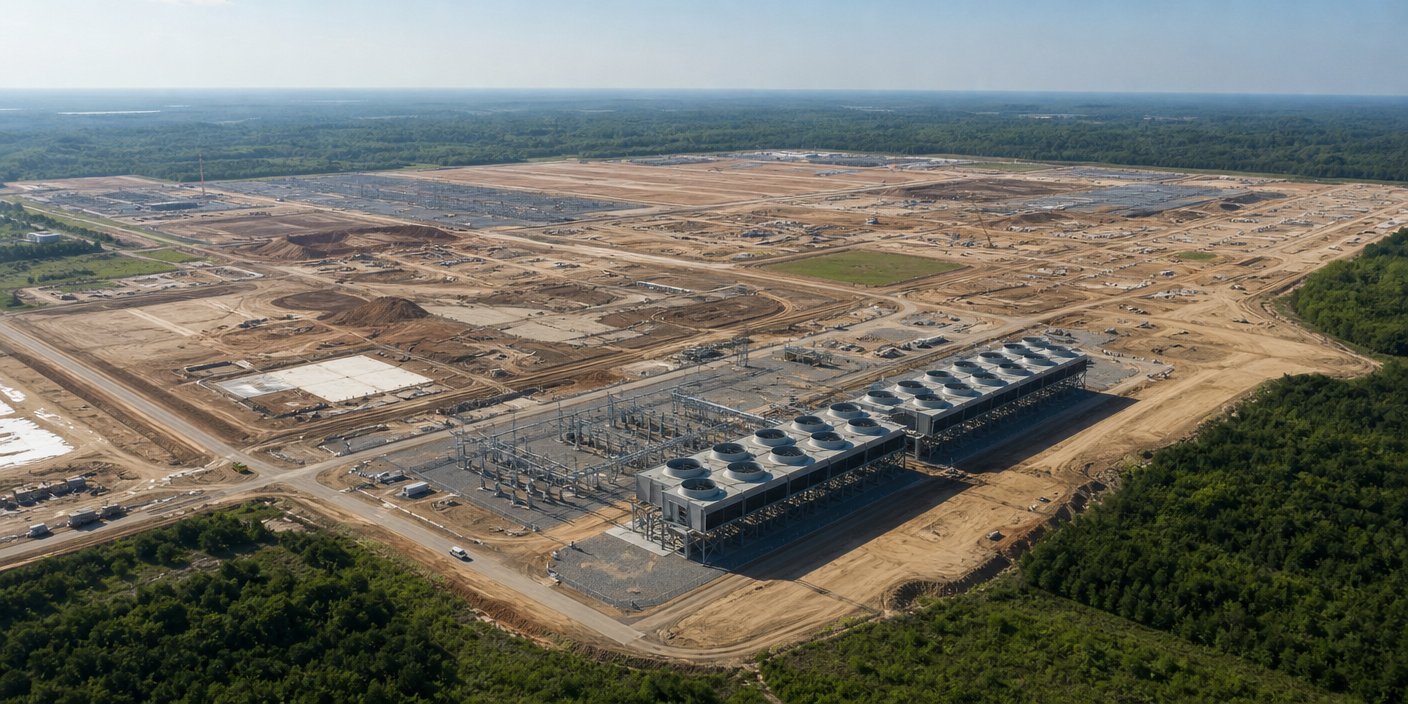
Elon Musk is orchestrating a monumental shift in the global technology landscape with the development of ‘Terafab,’ an unprecedented 100-million-square-foot industrial facility located in Grimes County, Texas. Situated on the site of the former Gibbons Creek Reservoir, this colossal project is a collaborative endeavor between Tesla, SpaceX, and xAI. The facility is being engineered to produce the staggering computing power necessary to fuel the next generation of artificial intelligence, humanoid robotics, and large-scale autonomous systems, establishing Texas as the undisputed epicenter of 21st-century compute infrastructure.
Key Highlights
- Scale of Engineering: The 100-million-square-foot facility is approximately 36 times the size of the Empire State Building’s total floor area, representing one of the largest single-site manufacturing and compute structures in human history.
- Strategic Location: Located on the repurposed Gibbons Creek Reservoir site in Grimes County, Texas, the project leverages ample land and existing infrastructure to support heavy industrial operations.
- Collaborative Power: The project acts as a nexus for Musk’s core ventures, pooling resources from Tesla, SpaceX, and xAI to accelerate the training of sophisticated AI models and the production of robotics hardware.
- Compute Supremacy: The primary mandate of Terafab is to secure a sovereign supply of high-performance compute power, insulating Musk’s companies from the volatile global semiconductor market.
The Architecture of Ambition: Understanding the Terafab Footprint
The sheer scale of the Terafab project necessitates a re-evaluation of industrial engineering. To visualize 100 million square feet is to look beyond traditional factory footprints and toward mega-structures that rival small city districts. By comparison, the Empire State Building, an architectural marvel of the 20th century, spans approximately 2.75 million square feet of interior space. Terafab is not merely a “large factory”; it is a tectonic shift in land use, designed to accommodate thousands of high-performance GPU clusters, sprawling robotic assembly lines, and the massive cooling and power infrastructure required to keep these systems operational around the clock.
The Math of Magnitude: Comparing Terafab to Global Landmarks
When analyzing the dimensions of Terafab, the “36 times” multiplier isn’t just hyperbole—it is a functional requirement. Modern AI training centers, particularly those training large language models (LLMs) and autonomous vehicle stacks, require massive physical footprints to house high-density server racks. The heat dissipation requirements alone demand an engineering layout that is expansive rather than vertically stacked. This facility is effectively a “Compute City,” built to prioritize horizontal expansion, allowing for modular upgrades and the continuous scaling of hardware as the demands of xAI’s Grok and Tesla’s Optimus robot evolve.
Computing for the Future: The Engine Behind xAI and Robotics
The core mission of Terafab is the consolidation of “compute sovereignty.” Currently, major tech firms are locked in a global competition for access to advanced GPUs. By constructing a proprietary facility of this scale, Musk is insulating his ecosystem from external supply chain bottlenecks. The facility is expected to act as the primary brain for the next generation of Tesla’s Full Self-Driving (FSD) stack, the large-scale model training for xAI, and the manufacturing precision required for SpaceX’s Starship development program. It is an infrastructure play that bets heavily on the premise that compute power will be the primary currency of the coming decade.
The Strategic Pivot: Converting Gibbons Creek into Silicon Valley 2.0
The selection of the Gibbons Creek Reservoir site in Grimes County is calculated. The site offers the unique advantages of existing utility capacity, substantial buffer zones for industrial operations, and a location that integrates into Texas’s growing reputation as a tech-friendly regulatory environment. The conversion of a former power plant reservoir site into a high-tech fabrication hub underscores a broader trend of repurposing heavy industrial real estate for modern data-intensive applications. This revitalization is expected to bring significant economic development to Grimes County, transitioning the local economy from its traditional utility roots to the forefront of the AI industrial revolution.
Cross-Company Synergy: Integrating Tesla, SpaceX, and xAI
Perhaps the most compelling aspect of Terafab is the collaborative governance. By sharing the footprint among Tesla, SpaceX, and xAI, Musk is creating a closed-loop resource system. SpaceX provides the aerospace-grade manufacturing expertise; Tesla provides the mass-market production capabilities and robotics integration; and xAI provides the software intelligence and neural net training. This vertical integration allows for rapid prototyping—where an AI model developed at xAI can be tested on a robot manufactured in the same facility, using hardware developed by the same engineering team, dramatically shrinking the R&D cycle.
FAQ: People Also Ask
Q: Why was the Gibbons Creek Reservoir site chosen for Terafab?
A: The site provides vast, contiguous land, existing utility infrastructure, and favorable proximity to Texas’s power grid, which is essential for the high-energy demands of massive AI compute arrays.
Q: Is Terafab only for Tesla vehicles?
A: No. Terafab is a joint venture involving Tesla, SpaceX, and xAI. Its purpose is to centralize compute and manufacturing resources for all three entities, ranging from FSD (Full Self-Driving) training to humanoid robotics and aerospace development.
Q: How does the size of Terafab compare to traditional tech facilities?
A: At 100 million square feet, Terafab is an order of magnitude larger than standard data centers or manufacturing plants, positioning it as one of the largest industrial developments currently planned in the United States.
Q: What is the primary output of this facility?
A: The primary outputs are highly specialized computing clusters for AI model training and robotic hardware assembly, serving as the physical backbone for Musk’s various technology enterprises.