

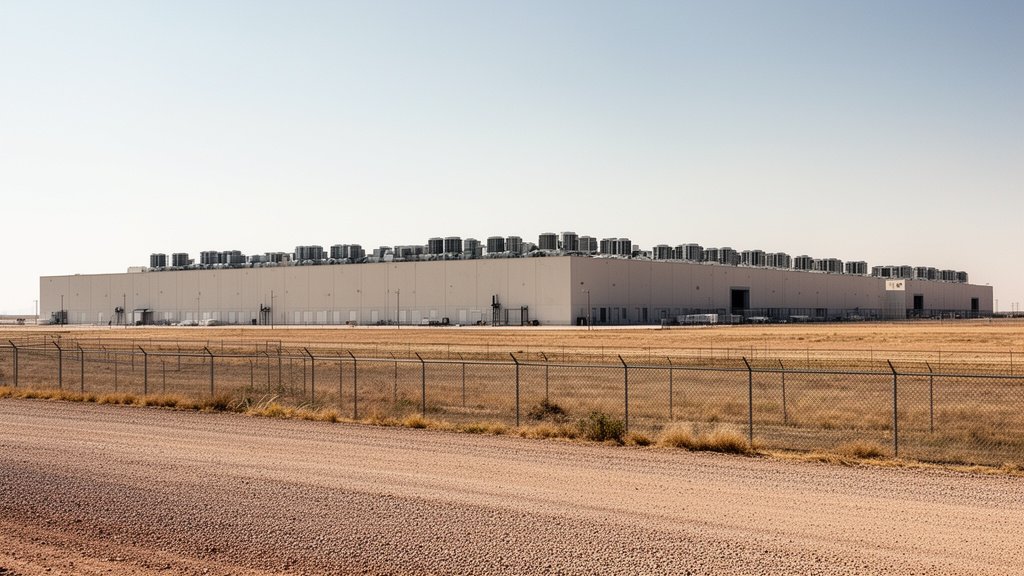
The drive to turn Texas into a global digital hub has come at a steep fiscal price, with new data revealing that local cities and counties have collectively forgone $1 billion in tax revenue to lure data center developments. While these facilities are often touted as economic engines, a closer examination of the incentives provided suggests a stark reality: the promised job creation—often promised in the hundreds—frequently fails to materialize at the scale projected, leaving local taxpayers to subsidize the infrastructure of global technology giants while reaping minimal long-term employment benefits.
Key Highlights
- $1 Billion Revenue Gap: Tax incentives granted to data centers across Texas have resulted in a cumulative loss of $1 billion in local government and school district revenue.
- Minimal Employment ROI: Data centers are highly automated; facilities representing millions in capital investment often support only a handful of permanent, full-time local operational roles.
- School District Impact: Much of the revenue forgone comes directly from property tax abatements that would have otherwise funded local Independent School Districts (ISDs).
- Shift in Policy: Legislative scrutiny is mounting as concerns grow over the long-term sustainability of using tax breaks to attract capital-intensive but labor-light industries.
The Economic Trade-Off: Capital vs. Careers
The fundamental conflict lies in the nature of the data center industry itself. These entities represent massive capital expenditure—often billions of dollars in hardware, real estate, and power infrastructure—but minimal operational expenditure regarding human capital. In the traditional economic development model, tax incentives are designed to attract labor-intensive industries, such as manufacturing or corporate headquarters, which act as multipliers for the local economy. Data centers, however, operate differently.
Once construction is complete, the operational phase of a data center requires a skeleton crew. Technicians, security personnel, and maintenance staff are necessary, but these roles are often specialized and do not reach the volume of jobs promised in the initial incentive applications. When municipalities offer property tax abatements—often under the guise of Chapter 312 or local incentive agreements—they are effectively subsidizing the building of a server farm that offers little in the way of a robust local workforce or consumer base.
The Mechanics of the Fiscal Drain
Why are these numbers so staggering? The answer lies in the cumulative effect of local tax abatements. When a county or city enters into a development agreement, they often freeze property tax valuations or rebate a significant percentage of property taxes over a ten-to-twenty-year period. While the capital investment is massive, the taxable value of that investment is significantly dampened by these agreements.
For school districts, this is particularly devastating. In Texas, school funding relies heavily on property tax revenue. When a data center receives a massive tax break, the state often does not fully backfill that lost revenue, meaning the district loses out on essential funding for operations, facilities, and teacher salaries. The industry argues that the data centers would not be built in these specific locations without these incentives, but critics point out that the growth of cloud computing is an inevitability, not a variable dependent on local tax handouts.
Infrastructure and Environmental Strain
Beyond the fiscal gap, there is the question of infrastructure usage. Data centers are notoriously resource-heavy, demanding massive amounts of electricity and, in many cases, water for cooling. As these facilities cluster in specific Texas regions to take advantage of energy grid accessibility, they place a disproportionate strain on local utilities.
When a community provides a tax break to a data center, they are essentially providing a discount on the infrastructure upkeep. Local residents often bear the cost of grid upgrades and water management improvements while the corporate entity pays a fraction of the property taxes compared to other commercial developments of similar scale. This creates a public-private imbalance where the public absorbs the risk and infrastructure degradation, while the entity captures the efficiencies of the location.
Future Policy Implications
The scrutiny of these billion-dollar giveaways comes at a pivotal time for Texas economic policy. With the expiration of Chapter 313 agreements, the state is at a crossroads regarding how it attracts industry. The prevailing sentiment among fiscal conservatives and community advocates alike is that the era of ‘blind’ incentives must end.
Future agreements will likely require stricter ‘clawback’ provisions—clauses that demand the return of tax incentives if specific, verifiable job-creation benchmarks are not met. Furthermore, there is a growing push for more transparency in how these incentives are calculated, ensuring that the public can see exactly what they are paying for in exchange for the presence of these high-tech monoliths. The data center industry remains a critical component of the digital economy, but the ‘Texas Model’ of subsidizing it may be forced to evolve into a more equitable arrangement for the citizens who host them.
FAQ: People Also Ask
Why do data centers get tax breaks if they don’t hire many people?
Local governments often compete with other states or regions to land these projects. The argument is that the massive capital investment—even if it creates few jobs—boosts the local tax base in the long run and attracts ancillary businesses or tech infrastructure, such as fiber optic networks.
How does this affect local schools?
In Texas, school districts are the largest recipients of property tax revenue. Tax abatements for data centers reduce the total taxable value within the district, which can lower the amount of funding available for school operations and capital projects unless the state covers the difference.
Will the $1 billion loss eventually be recovered?
It is unlikely. Most tax incentives are structured as long-term abatements. Once the tax revenue is forgone, it is permanently lost to the taxing entity, regardless of future profitability of the data center.
Are data centers considered ‘clean’ industries?
They are often marketed as clean because they do not have smokestacks or manufacturing waste. However, they are intense consumers of electricity and water, which raises concerns about environmental sustainability and infrastructure strain in arid or energy-constrained regions.