
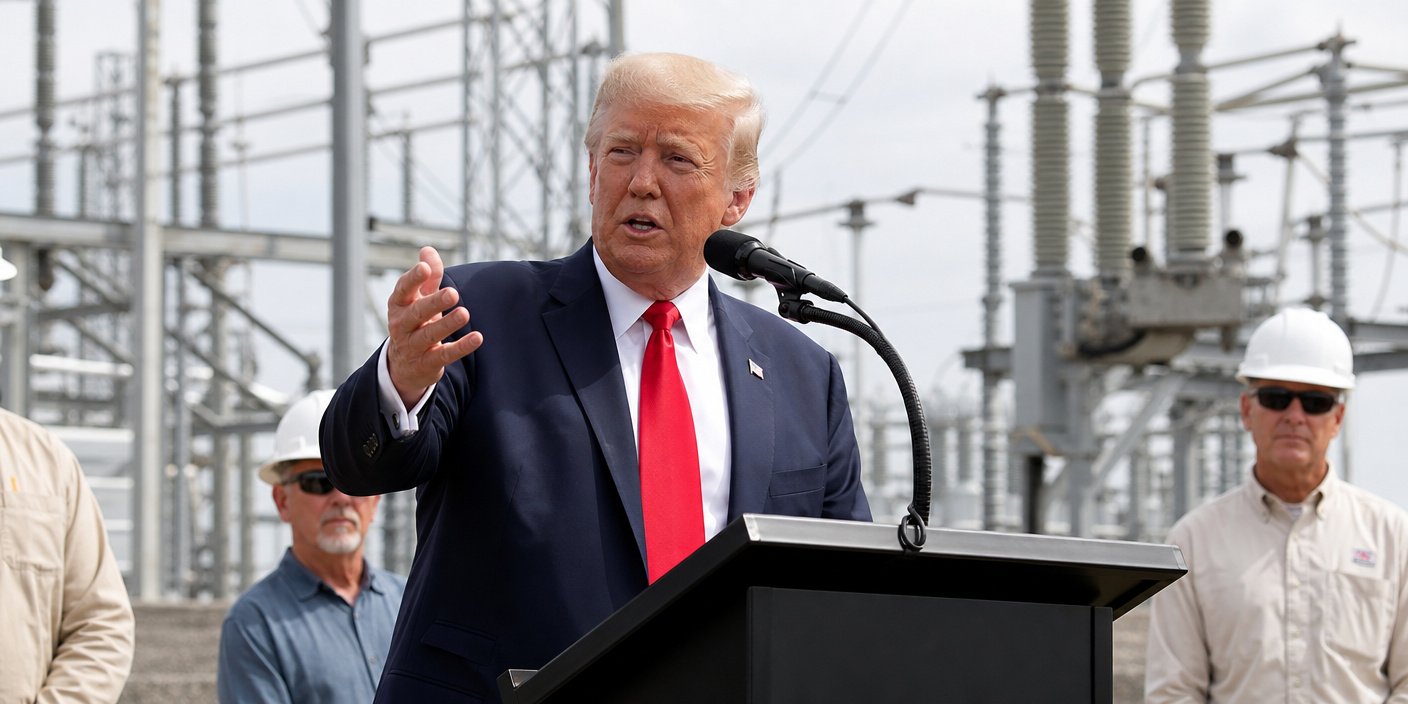
The intersection of artificial intelligence, energy infrastructure, and political posturing has reached a critical boiling point in Texas. Former President Donald Trump has publicly criticized Texas Governor Greg Abbott’s recent decision to pause new interconnection approvals for large-scale data centers. While the Governor’s administration cites grid stability and resource transparency as the core drivers for the temporary freeze, Trump has framed the decision as a strategic error that could stifle economic development and national technological dominance.
Key Highlights
- Public Disagreement: Former President Donald Trump labeled the Texas data center pause a “mistake,” arguing it hinders U.S. competitiveness in the booming AI sector.
- The Grid Argument: Governor Greg Abbott’s office defends the pause as a data-driven security necessity, specifically citing a lack of transparency regarding power and water consumption from applicants.
- The Balancing Act: The policy friction highlights the intensifying struggle between Texas’ rapid industrial expansion and the capacity limitations of the Electric Reliability Council of Texas (ERCOT) grid.
- Economic vs. Security: The conflict underscores a growing national debate over whether to prioritize rapid technological growth or infrastructure resiliency in an era of climate-driven energy instability.
The Power Struggle: Infrastructure vs. Innovation
The friction between Trump and Abbott brings to the forefront a complex dilemma facing major industrial hubs across the United States. As data center operators—spurred by the unprecedented power demands of generative AI and cryptocurrency mining—scramble for real estate in Texas, the state’s electrical grid has faced immense pressure.
The Collision of Tech Ambition and Grid Capacity
The core of the controversy lies in the voracious power requirements of modern high-performance computing. Data centers are not merely office buildings; they are industrial-scale energy consumers that require constant, uninterrupted cooling and power. For Texas, which has long marketed itself as a pro-business, deregulation-heavy haven for tech investment, this sudden throttle on growth represents a significant shift in policy.
Trump’s characterization of the move as a “mistake” aligns with his broader political platform, which emphasizes deregulation and the aggressive pursuit of technological superiority, particularly regarding AI development. By restricting these interconnections, Trump argues, Texas risks losing its edge to other jurisdictions or international competitors who may not be as hesitant to accommodate the massive electricity load required for future-proof AI models.
The Data-Driven Security Stance
Conversely, Governor Greg Abbott’s administration maintains that the pause is not an anti-growth measure but a necessary, data-driven security precaution. The Governor’s office has pointed to a lack of transparency among applicants, many of whom have historically failed to provide clear, actionable projections regarding their total power draw and water consumption—the latter being a critical and often overlooked resource in the cooling processes of server farms.
By halting new approvals, the state is attempting to force a higher standard of disclosure. The objective is to map out exactly how much load these facilities will place on the grid before they are integrated. This is a critical distinction for the Texas grid, which has suffered from high-profile outages in the past and is currently managing a complex transition toward renewable energy integration alongside traditional base-load power sources.
The Future of Texas’ Digital Economy
The long-term implications of this policy standoff are profound. If Texas continues to pause data center growth, it could create a bottleneck for AI and cloud computing investment in the state. However, if it proceeds without adequate planning, the state risks destabilizing its grid, which could have even more disastrous economic consequences. The “mistake” described by Trump may well be a necessary administrative pause, or it could be an early indicator of a fracturing relationship between industry giants and state regulators.
As the state gathers more data, the ultimate outcome will likely define how American states manage the “energy-for-data” trade-off in the coming decade. Whether the pause is lifted with new, stringent requirements or results in a broader legislative overhaul of how Texas manages its energy resources remains the central question for stakeholders.
FAQ: People Also Ask
1. Why did Texas pause data center interconnection approvals?
The Governor’s office implemented the pause primarily to address concerns regarding the stability of the ERCOT power grid and to force transparency. Many developers were failing to disclose full power and water consumption projections, which are essential for infrastructure planning.
2. How does Trump’s critique impact the situation?
Trump’s public disapproval of the pause places political pressure on the Texas state government to accelerate the approval process. It frames the issue not as a grid management problem, but as a strategic economic failure that could disadvantage the U.S. in the global AI arms race.
3. Do data centers really consume that much water?
Yes. While they consume massive amounts of electricity for processing power, data centers also require significant water resources for cooling systems. In arid or drought-prone regions like parts of Texas, this consumption becomes a critical environmental and civic concern.
4. Is this pause permanent?
No. The administration has categorized the measure as a pause or temporary halt, intended to allow regulators to gather sufficient data and develop better transparency requirements for future applicants. It is not currently framed as a total ban on the industry.