
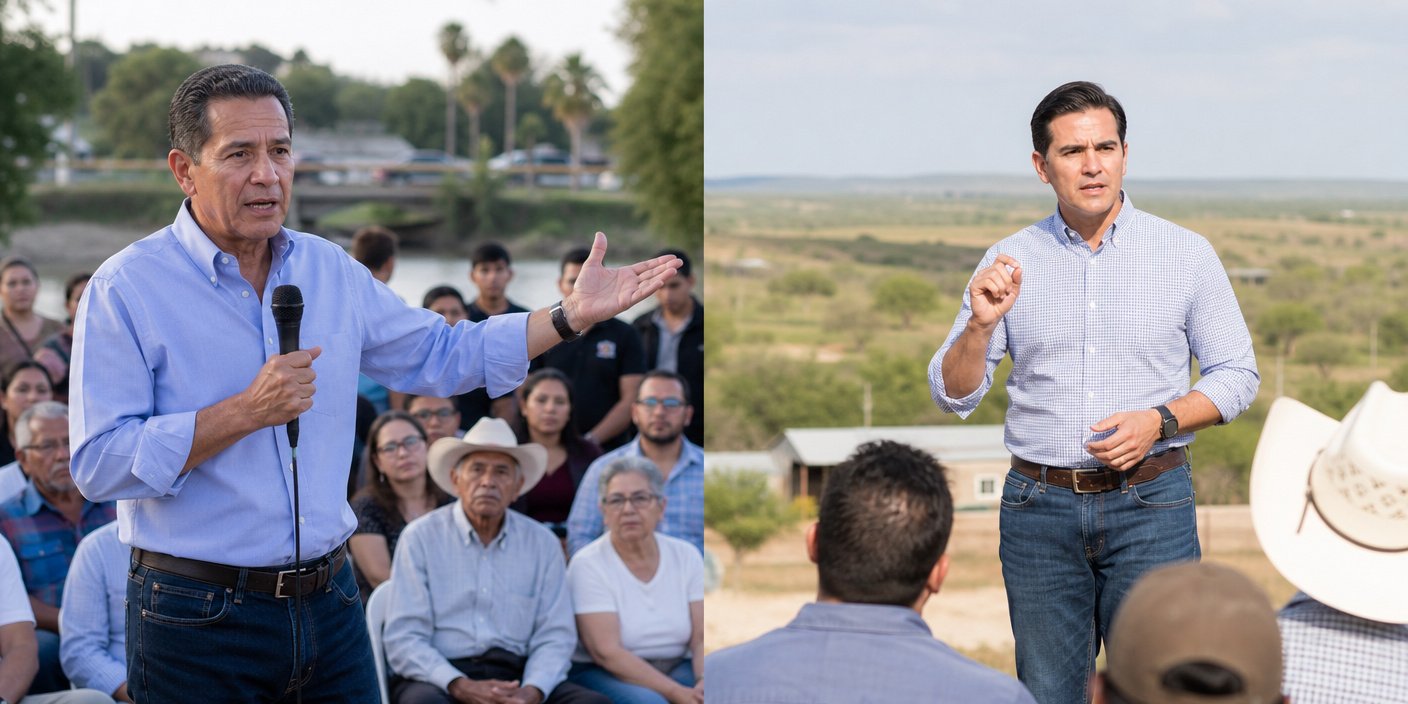
In the heart of the Rio Grande Valley, the race for Texas’s 34th Congressional District has emerged as a crucial litmus test for national political trends. Democratic incumbent Rep. Vicente Gonzalez and Republican challenger Eric Flores are locked in an intense battle that underscores the profound ideological divide shaping the current election cycle. With district lines redrawn to favor Republican leanings and recent polling showing significant movement in the region, both campaigns are navigating a landscape where local issues are inextricably linked to the national political brands of President Joe Biden and former President Donald Trump.
The Nationalization of Local Politics
The 34th Congressional District, historically a Democratic stronghold, has become a primary target for the National Republican Congressional Committee (NRCC), which views the region as ripe for a paradigm shift. The race has increasingly moved away from hyper-local concerns toward a referendum on national party leadership. Rep. Vicente Gonzalez, the Democratic incumbent, finds himself defending the Biden administration’s record against a barrage of critiques from Eric Flores, whose campaign platform is built upon alignment with the Make America Great Again (MAGA) agenda.
For voters in the region, the ballot is increasingly seen as a choice between two distinct national trajectories. Flores has successfully pushed the narrative that the current administration has abandoned South Texas, citing the inflation of the last few years and the federal government’s approach to the energy sector as evidence. Gonzalez, conversely, has attempted to pivot the conversation toward bipartisan infrastructure investments and local economic development, arguing that his challenger represents an extremist wing of the Republican party that is out of touch with the specific needs of the Rio Grande Valley.
Immigration: The Defining Wedge
Perhaps no issue looms larger in this race than immigration. The district covers a substantial stretch of the U.S.-Mexico border, making it the epicenter of the national debate over border security and asylum policy. The Ground Truth of this race is defined by the security vacuum perceived by local residents, which Eric Flores has capitalized on heavily. By tying Gonzalez to the Biden administration’s border policies—which Flores characterizes as a “national security failure”—the Republican challenger has galvanized the conservative base and captured the attention of undecided voters who are weary of the current border volatility.
Rep. Gonzalez has faced a difficult balancing act, frequently stressing his support for orderly, legal immigration while simultaneously calling for increased resources and enforcement at the border. This “middle-ground” approach, however, has proven difficult to defend against a challenger who effectively utilizes high-contrast rhetoric regarding border “invasions.” The visual and visceral impact of the border crisis on the daily lives of constituents in the 34th District provides a constant, tangible backdrop for Flores’s campaign ads, making it difficult for the incumbent to steer the debate toward more traditional Democratic talking points.
Economic Priorities and the Energy Sector
Beyond the border, the economy remains a critical fault line. The Rio Grande Valley is heavily reliant on industries that are often the target of federal regulatory shifts, particularly in energy. Flores has framed the Biden administration’s environmental regulations as a direct threat to the regional economy, particularly to oil and gas workers who feel marginalized by federal green energy initiatives. By positioning himself as a defender of traditional Texas energy, Flores has tapped into a deep vein of economic anxiety.
Rep. Gonzalez has attempted to counter this by highlighting his role in securing federal funds for the district, emphasizing that his “ties” to the Democratic leadership in Washington result in tangible, dollar-denominated benefits for the district’s infrastructure and schools. However, in an inflationary environment where gas prices and grocery costs are high, the argument for “federal investment” often struggles to compete with the visceral, pocketbook-focused messaging of the opposition.
Demographic Shifts and Future Predictions
The shift in the 34th Congressional District is not accidental; it is part of a broader, well-documented trend of Hispanic voters in South Texas moving toward the Republican party. This demographic realignment has surprised many political analysts who previously viewed the region as safely blue. If Flores manages to unseat Gonzalez, it would not only signify a major victory for the GOP but would likely accelerate national party investments into South Texas for decades to come.
Conversely, if Gonzalez holds the seat, it will likely be viewed as a signal that the “Hispanic shift” toward the GOP has a ceiling and that localized, candidate-specific campaigning can still overcome national tailwinds. The race is essentially a tug-of-war for the future identity of South Texas politics.
FAQ: People Also Ask
Why is the 34th Congressional District considered so competitive?
It has been redrawn to be more favorable to Republicans, and regional shifts in voter sentiment toward the GOP have turned a once-safe Democratic seat into a national battleground.
What are the main issues in the Vicente Gonzalez vs. Eric Flores race?
The primary issues include border security and immigration policy, the rising cost of living and inflation, and the impact of federal energy policies on the local economy.
How does the national party alignment affect local voters?
Voters are increasingly viewing local congressional races as referendums on national leaders like President Biden and Donald Trump. Candidates are actively using their association—or dissociation—with these figures to define their platforms and mobilize voters.
What demographic changes are influencing the race?
There has been a documented trend of Hispanic voters in the Rio Grande Valley moving toward the Republican party, a shift that is challenging long-standing Democratic dominance in the region.