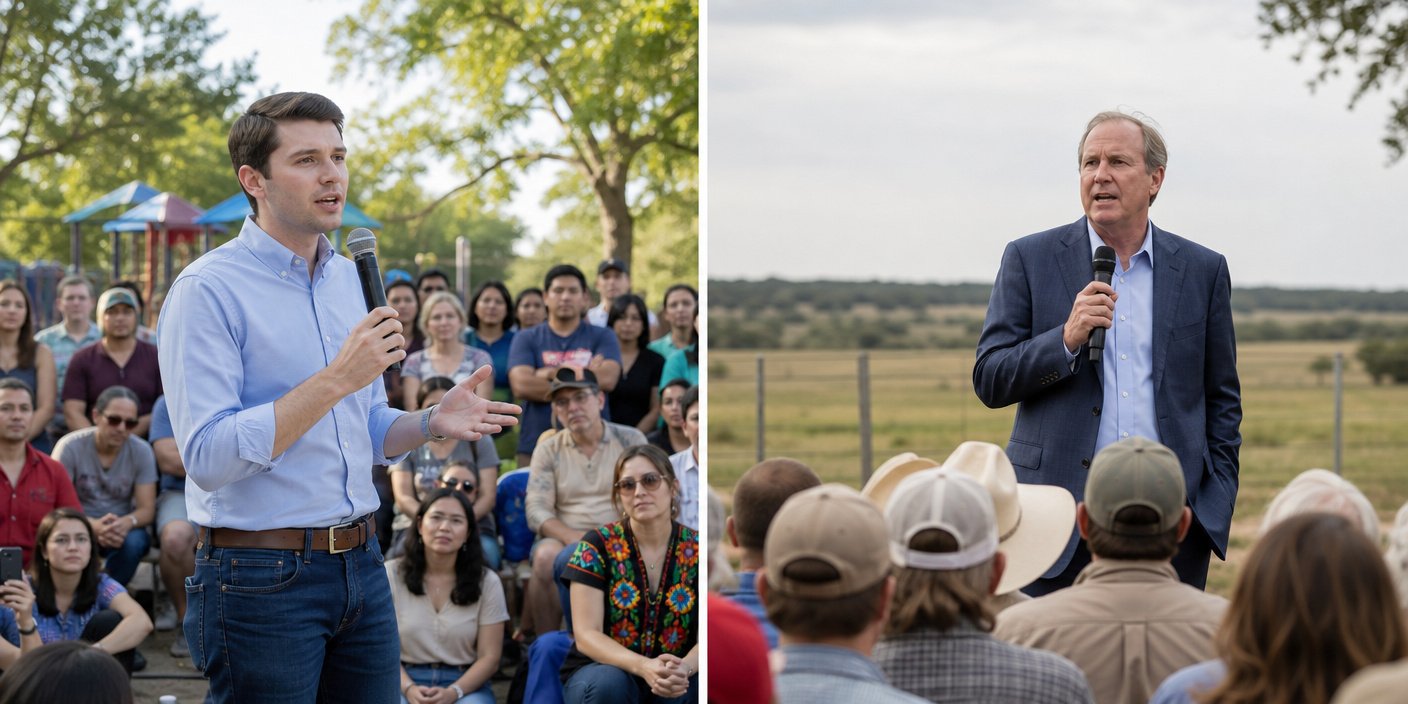
A new poll has sent shockwaves through the political establishment, indicating that Democrat James Talarico holds a narrow 47%-45% lead over Republican incumbent Ken Paxton in the pivotal Texas U.S. Senate race. This statistical development, reflecting a highly competitive election cycle, underscores a tightening contest in what has long been considered a bedrock of Republican power. The survey, which captures the current pulse of the electorate, suggests that the traditional margins of victory in the Lone Star State may be increasingly vulnerable to shifting voter sentiments.
Key Highlights
- Narrow Lead: James Talarico (D) leads Ken Paxton (R) with 47% to 45%, a margin within the poll’s typical range of error.
- Shift in Dynamics: The race reflects an intensifying battle for the Texas Senate seat, suggesting traditional GOP dominance is facing unprecedented friction.
- Deciding Factors: Analysts point to suburban engagement, economic anxiety, and demographic evolution as key drivers for this polling shift.
The Tightening Texas Landscape and Shifting Voter Baselines
The emergence of a competitive race between Talarico and Paxton represents a significant pivot point for Texas politics. For decades, the Texas Senate seat has been viewed as a secure firewall for the Republican party, a bastion of conservative policy and a reliable source of GOP electoral college votes. However, the latest figures suggest that the political environment is in a state of flux. The 47%-45% split is not merely a statistical anomaly; it serves as a bellwether for a broader trend of demographic and ideological migration across the state.
Analyzing the Demographic Pivot
Recent electoral trends in Texas have consistently shown a migration of moderate voters away from the traditional Republican base. This is particularly evident in the rapidly growing metropolitan areas, where issues surrounding infrastructure, public education funding, and state-level governance have moved to the forefront of the public consciousness. James Talarico, often characterized by his work in the Texas House, has leveraged his platform to tap into this suburban dissatisfaction. The data suggests his campaign is successfully connecting with independents who were previously aligned with moderate GOP platforms but are now feeling alienated by the current political trajectory of the state party.
The Paxton Strategy: Defending the Incumbent
Conversely, Ken Paxton’s strategy remains focused on shoring up his base. As a prominent figure within the Republican party, Paxton’s campaign is betting heavily on the mobilization of rural voters and the reinforcement of core conservative values, including border security and fiscal restraint. The 45% figure indicates that his traditional base remains engaged, but the two-point deficit suggests a potential ‘enthusiasm gap’ or a failure to capture the crucial swing-voter demographic that typically decides statewide elections in Texas. For Paxton, the pathway to victory involves pivoting from his base-focused rhetoric to a broader message that addresses the economic anxieties impacting middle-class Texans.
Economic and Cultural Catalysts
Beyond the candidates themselves, the economic climate is playing a disproportionate role in this cycle. High inflation, housing market volatility, and the rising cost of living have transformed the political dialogue. Both candidates are attempting to frame the economic narrative in their favor—Talarico highlighting the need for systemic support for working families, and Paxton emphasizing the importance of deregulation and business-friendly policies. As these economic pressures mount, the electorate is increasingly looking for specific, actionable solutions rather than abstract ideological positioning, and this search for pragmatism appears to be favoring a change in representation.
The Future of Texas Electoral Politics
If the current polling holds, this election will be remembered as the moment Texas transitioned from a ruby-red stronghold to a true battleground state. The implications extend far beyond the Senate seat itself. A victory for either candidate would set the tone for the next decade of Texas legislative priorities. The challenge for the Talarico campaign will be sustaining this momentum through the final months, while the Paxton campaign must find a way to re-capture the margins that have historically kept their party in power. Regardless of the outcome, the 47%-45% split is a definitive signal that the status quo in Texas politics is no longer a guarantee.
FAQ: People Also Ask
Q: How reliable is the new poll showing the 47%-45% split?
A: While polls are snapshots in time and subject to margins of error, this data reflects a highly competitive cycle. Political analysts advise looking at the trend lines of multiple polls rather than a single survey to understand the trajectory of the race.
Q: What are the main issues driving the Texas Senate race?
A: Voter sentiment is heavily influenced by the economy, specifically inflation and housing costs, alongside recurring discussions on public education, border policy, and the role of the state government in local affairs.
Q: How has the Texas electorate changed in recent years?
A: Texas has seen significant population growth, particularly in suburban and urban corridors. These new residents, along with shifts in voting behavior among suburban demographics, are increasingly breaking the traditional patterns of partisan dominance in the state.