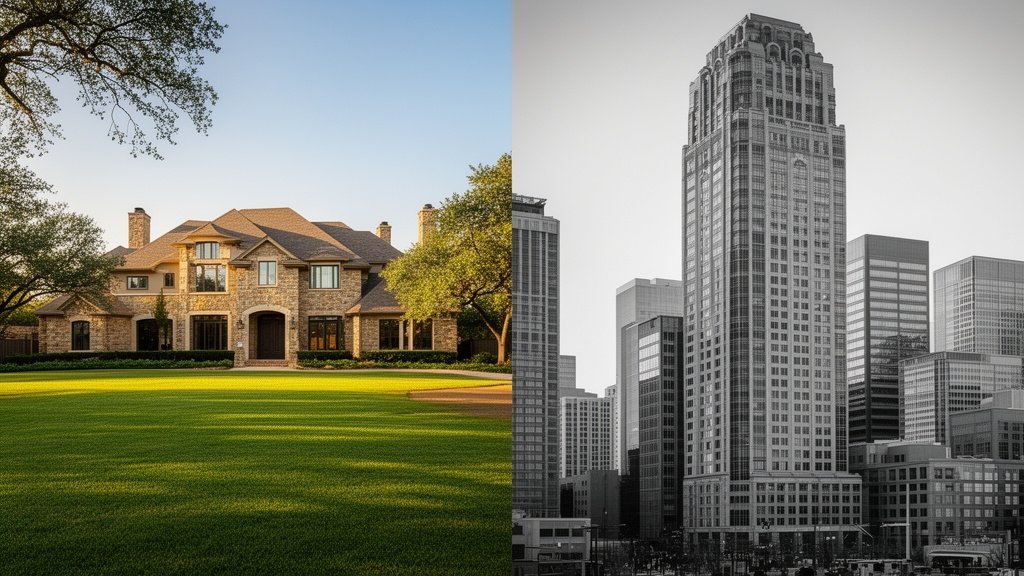
The Texas real estate market is currently navigating a period of profound divergence, characterized by high-end residential ambition in Fort Worth and significant commercial distress in downtown Dallas. Recent reports from The Real Deal highlight this stark dichotomy: while the residential sector is reaching new heights with a $28 million luxury listing in Fort Worth, the commercial landscape is grappling with a $98 million foreclosure on a prominent downtown Dallas office tower. This shift suggests that capital is becoming increasingly selective, flowing toward tangible, aspirational residential assets even as the commercial office sector struggles to find its footing in a post-pandemic economic environment.
Key Highlights
- Record Residential Ambition: A rare $28 million residential listing in Fort Worth signals strong confidence in the city’s luxury market, drawing wealthy buyers away from traditional urban centers.
- Commercial Market Headwinds: A $98 million foreclosure on a downtown Dallas office tower underscores the ongoing liquidity challenges facing aging or underutilized commercial office spaces.
- Market Divergence: The simultaneous high-value residential activity and commercial distress point to a maturing Texas market where location and asset type are critical predictors of performance.
- Wealth Migration: The movement of capital toward Fort Worth residential real estate suggests a broader trend of high-net-worth individuals prioritizing lifestyle-oriented, lower-density assets over core business district density.
The Bifurcation of the Lone Star Market
The dual narrative of the $28 million Fort Worth residential listing and the $98 million Dallas commercial foreclosure is more than just a coincidence of timing; it is a clear indicator of a market in flux. Historically, Dallas and Fort Worth have grown in tandem, often viewed by investors as a single monolithic entity: the Dallas-Fort Worth (DFW) Metroplex. However, recent data suggests that the two cities are beginning to command different investment profiles, especially as capital allocation strategies shift in response to interest rate environments and return-to-office realities.
The Rise of Fort Worth Luxury
Fort Worth has long positioned itself as the more subdued, cultural, and historically grounded sibling of Dallas. The arrival of a $28 million residential listing in the Fort Worth market is an outlier that signals a maturation of the local luxury landscape. Such high-ticket listings are typically reserved for the most exclusive zip codes in Dallas—such as Highland Park or Preston Hollow. Their appearance in Fort Worth suggests that the city is successfully attracting the “new money” and high-net-worth individuals who were previously anchored to the Dallas inner-loop or coastal markets. This migration is driven by a desire for acreage, privacy, and the unique brand of “cowboy luxury” that defines the Fort Worth experience. Analysts suggest that if these high-priced properties continue to trade, it could permanently elevate the valuation ceiling for Tarrant County estates, effectively bridging the gap between Fort Worth and the traditional prestige markets of Dallas.
Commercial Distress in Downtown Dallas
Conversely, the $98 million foreclosure on a downtown Dallas office tower serves as a sobering reminder of the structural changes affecting the commercial real estate (CRE) sector. As vacancy rates remain elevated in major metropolitan office markets, the Dallas central business district is not immune to the “flight to quality” phenomenon. Office properties that lack modern amenities, efficient floor plates, or high-end sustainability certifications are increasingly finding themselves over-leveraged and under-occupied. The foreclosure serves as a case study in the risks associated with older Class B and even some Class A office buildings that have failed to secure long-term tenants in a world where hybrid work is the new norm. For investors, this event signals a pivot toward “distressed asset” acquisition strategies, where private equity firms and opportunistic buyers are looking to repurpose these assets, potentially pivoting them into residential, hospitality, or mixed-use developments.
Economic Implications and Future Outlook
What does this mean for the Texas economy? The migration of wealth toward Fort Worth residential real estate serves as a hedge against the volatility seen in the commercial office sector. While commercial foreclosures generate headlines about instability, the resilience and growth of the luxury residential sector suggest that underlying consumer demand in Texas remains robust. Wealthy individuals are not fleeing Texas; they are simply changing where they choose to plant their roots. The future of the Metroplex likely involves a more decentralized model, where the success of a city is less about the density of its downtown skyline and more about the quality of its residential lifestyle offerings. Investors are watching closely to see if the commercial distress in Dallas will trigger a broader pricing correction, or if it will be isolated to underperforming assets while prime residential real estate continues to appreciate.
FAQ: People Also Ask
Why is there a $98 million foreclosure in Dallas?
The foreclosure is primarily driven by the systemic challenges facing the commercial office market, including high vacancy rates, the shift toward hybrid work models, and the difficulty of refinancing loans on aging office assets in a high-interest-rate environment.
Does the $28M listing indicate a bubble in Fort Worth?
Not necessarily. While it is a record-breaking figure for the area, it reflects a long-term trend of wealth migration toward Fort Worth, driven by demand for exclusive residential estates that offer more space and privacy than traditional Dallas-area luxury markets.
How will these trends affect future real estate investors?
Investors are likely to adopt a more bifurcated strategy. We expect to see more “flight to quality” in the office sector (investing only in top-tier, modern assets) and a continued, aggressive pursuit of high-end residential assets in emerging luxury hubs like Fort Worth.
What are the key differences between the Dallas and Fort Worth markets?
Historically, Dallas has been the financial and commercial heart of the Metroplex. Fort Worth is increasingly developing its own identity as a luxury lifestyle and cultural hub, attracting residents who prioritize community feel and residential exclusivity over urban commercial density.