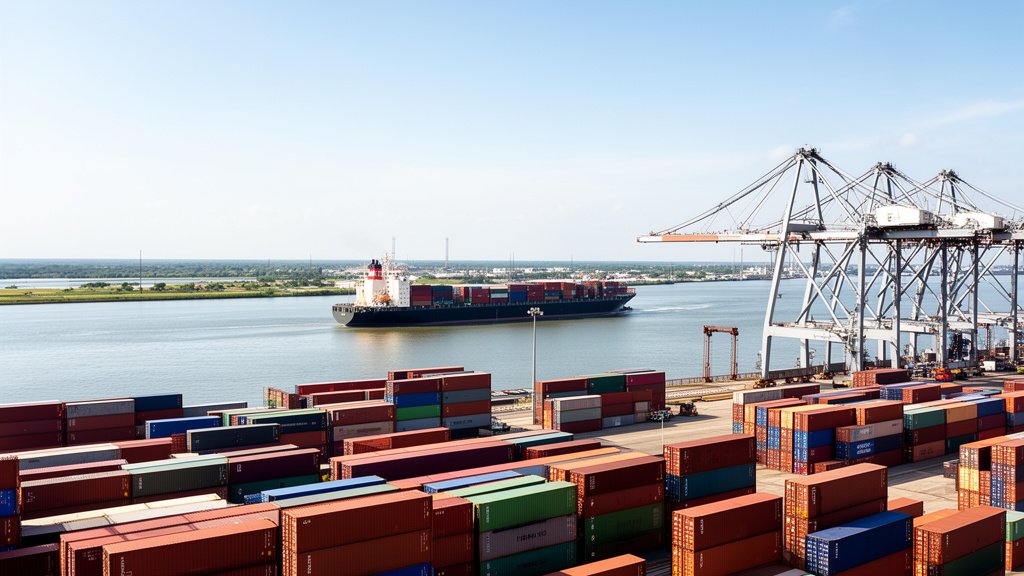
Port Houston has officially marked a significant milestone in its long-term infrastructure strategy, following a critical September 2026 meeting that solidified a new land development agreement with the U.S. Army Corps of Engineers (USACE). This partnership, centered on the strategic utilization of Pelican Island, is set to drastically enhance the port’s capacity to handle increasing export volumes, while simultaneous operational tariff updates aim to streamline vessel throughput and terminal efficiency. As the primary gateway for U.S. energy exports, this expansion represents a pivot toward modernizing logistics to meet the escalating demands of global trade.
Key Highlights
- Strategic Land Agreement: Port Houston and the U.S. Army Corps of Engineers (USACE) have entered a pivotal land development agreement focusing on Pelican Island to support future maritime and industrial expansion.
- Optimizing Throughput: The Port Commission has ratified new operational tariff updates designed to maximize terminal efficiency and encourage rapid cargo turnover.
- Export Growth: These initiatives are specifically engineered to accommodate the surge in U.S. energy and petrochemical exports moving through the Houston Ship Channel.
- Logistics Integration: The project aims to integrate land-side development with ongoing channel dredging operations, ensuring a unified approach to maritime infrastructure.
Advancing Maritime Infrastructure at Pelican Island
The agreement regarding Pelican Island is not merely a land-use decision; it is a foundational shift in how Port Houston manages its physical footprint. For years, Pelican Island has been viewed as a high-potential asset, situated strategically at the mouth of the Houston Ship Channel. The partnership with the U.S. Army Corps of Engineers is vital because it aligns port development with USACE’s dredging and maintenance responsibilities. By securing this agreement, the Port gains the ability to transform previously underutilized acreage into high-value logistical real estate.
This development is expected to address the critical need for additional space to handle the processing and storage of cargo. As vessels traversing the Houston Ship Channel grow in size—thanks to recent widening and deepening projects—the demand for land-side support facilities has grown proportionally. This development will provide the necessary infrastructure to handle containerized exports, break-bulk, and potentially, new energy transition assets, positioning the port as a multi-modal hub of the future.
Efficiency via Tariff Innovation
Alongside the physical expansion, Port Houston has introduced nuanced changes to its operational tariffs. In the world of global logistics, every hour counts. These tariff updates are strategically designed to incentivize higher efficiency among terminal operators and logistics providers. By adjusting fee structures, the Port is encouraging the rapid movement of goods, which prevents the bottlenecking that can plague major global trading hubs.
These adjustments are expected to reduce dwell times for trucks and rail, creating a leaner operation that benefits exporters. For global supply chains, predictability is often more valuable than raw capacity. By smoothing out the friction in the terminal workflow, Port Houston is reinforcing its competitive advantage against other major North American ports, ensuring that exporters can rely on the Houston gateway as a stable, high-velocity route to international markets.
The Economic Ripple Effect
The broader impact of these developments cannot be overstated. Port Houston serves as an essential economic engine for the Texas Gulf Coast and the United States at large. By expanding capacity at Pelican Island and optimizing tariff structures, the Port is effectively lowering the cost of doing business for energy producers and manufacturers across the region.
Industry analysts project that this expansion will have a multiplier effect on local employment. The construction phase alone will demand a significant specialized workforce, while the long-term operation of new terminal facilities will create a sustained demand for maritime logistics professionals, terminal operators, and supply chain managers. Furthermore, the ability to process higher volumes of exports positions the U.S. to maintain its aggressive energy export targets, a core component of the current national economic strategy.
FAQ: People Also Ask
1. Why is the Pelican Island agreement significant for Port Houston?
Pelican Island provides a critical land mass for infrastructure expansion. This agreement allows the Port to develop this land to support larger cargo volumes, directly facilitating the growth of export-heavy industries and supporting the logistics chain required for the Houston Ship Channel’s increasing traffic.
2. How do the new operational tariff updates affect exporters?
The tariff updates are designed to incentivize efficiency and faster throughput. By creating financial structures that reward rapid cargo turnover, the Port aims to reduce congestion and dwell times, making the export process faster, more predictable, and more cost-effective for businesses utilizing the port.
3. What is the role of the U.S. Army Corps of Engineers in this project?
The USACE is responsible for the maintenance and deepening of the Houston Ship Channel. Their partnership with Port Houston ensures that land development (like that on Pelican Island) is coordinated with dredging projects, maximizing the use of dredged material and ensuring that land-side and water-side operations are fully integrated and sustainable.
4. Will this expansion impact the environment?
Port Houston is mandated to comply with strict environmental oversight as part of its partnership with the USACE. All developments, including those on Pelican Island, undergo rigorous environmental impact assessments to ensure that expansion does not jeopardize the sensitive ecological balance of the Galveston Bay and Houston Ship Channel ecosystems.