

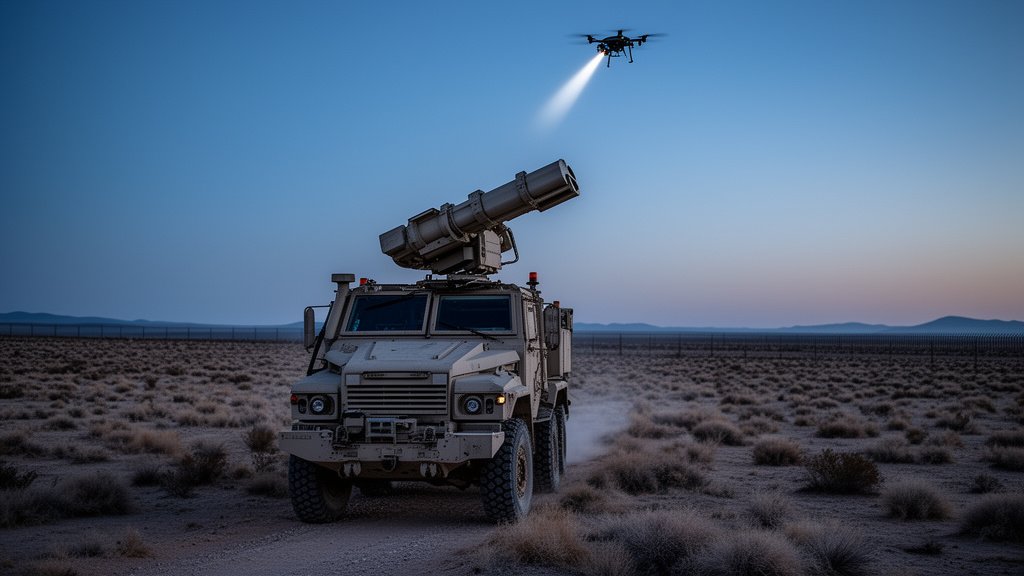
In a decisive demonstration of next-generation defensive capabilities, U.S. Joint Task Force – Southern Border personnel successfully engaged and destroyed three cartel-linked surveillance drones on August 25 and 26. The engagement utilized the Army Multipurpose High Energy Laser (AMP-HEL) system, marking a critical escalation in the military’s ability to counter airborne reconnaissance used by transnational criminal organizations. This operational success highlights a fundamental shift in how federal agencies address the persistent threat of aerial surveillance, which has long been leveraged by cartels to monitor patrol movements and coordinate human-smuggling support across remote border sectors.
Key Highlights
- Precision Engagement: The AMP-HEL system successfully neutralized three hostile surveillance drones during operations on August 25 and 26.
- Technological Edge: The deployment represents a significant pivot from signal jamming to active, kinetic destruction of unmanned aerial systems (UAS).
- Operational Impact: By eliminating cartel ‘eyes’ in the sky, federal forces have disrupted the tactical coordination necessary for illegal smuggling operations.
- Future-Ready Defense: This success validates the integration of directed-energy technology within Joint Task Force – Southern Border protocols.
Precision Defense: The AMP-HEL Breakthrough
The engagement involving the Army Multipurpose High Energy Laser (AMP-HEL) is not merely a tactical victory; it is a profound technological watershed moment for border security. For years, the cat-and-mouse game between law enforcement and cartel spotters has relied on passive measures, such as radio frequency (RF) jamming or visual spotting. These traditional methods have inherent limitations: jamming can be circumvented by autonomous drone flight paths, and human spotting is often reactive rather than preventative. The AMP-HEL system fundamentally changes this dynamic by moving to a directed-energy paradigm.
Directed-energy weapons (DEW) operate at the speed of light, providing a nearly instantaneous response to aerial threats. Unlike kinetic projectiles, which require complex targeting calculations for moving targets and pose collateral risks, a high-energy laser focuses intense heat on a target’s critical components—such as flight controllers, rotors, or batteries—causing immediate structural failure. The August 25-26 operations demonstrated that this technology is not only feasible in field conditions but highly effective against the specific class of commercial drones favored by cartel reconnaissance units.
Tactical Engagement and The Aerial Gap
Cartels have increasingly relied on Small Unmanned Aerial Systems (sUAS) to overcome the vast, rugged terrain of the southern border. These drones function as force multipliers for smugglers, providing real-time data on the position of U.S. Border Patrol agents, identifying gaps in sensor coverage, and timing smuggling crossings to maximize the chance of evasion.
By systematically neutralizing these assets, the Joint Task Force has created a ‘tactical blind spot’ for cartel operatives. The successful engagement of three drones over a two-day period suggests a highly effective detection-to-neutralization pipeline. This requires not only the laser itself but also a sophisticated sensor-fusion architecture—likely incorporating radar, electro-optical/infrared (EO/IR) cameras, and acoustic sensors—to identify, track, and lock onto these relatively small, low-signature targets in the challenging, cluttered environment of the desert.
The Future of Border Security Infrastructure
The integration of AMP-HEL signals a broader evolution in border security. As cartel technology advances, so too must the defensive posture of the United States. This engagement highlights a move toward a multi-layered defense strategy where Directed-Energy Weapons provide the ‘hard-kill’ capability necessary to deny cartels the ability to maintain situational awareness.
Looking ahead, the scalability of such systems is the next major hurdle. While laser systems offer an exceptionally low cost-per-shot compared to traditional interceptor missiles, the challenge lies in maintenance, power requirements, and operational versatility across diverse border terrains. However, the successful execution on August 25 and 26 provides a compelling proof-of-concept that high-energy lasers are destined to become a permanent fixture in the defense of national sovereignty along the border, shifting the advantage back toward the defenders.
FAQ: People Also Ask
Q: How does the AMP-HEL system destroy drones?
A: The Army Multipurpose High Energy Laser (AMP-HEL) uses a concentrated beam of high-intensity light to heat the target. By focusing this energy on critical components like the drone’s rotors or electronics, the system causes the aircraft to fail structurally or lose control, effectively destroying it mid-air.
Q: Why are drones a threat at the southern border?
A: Cartels use drones for surveillance to monitor the positions of Border Patrol agents and law enforcement. This aerial intelligence allows them to time human and narcotics smuggling operations, identifying gaps in patrol coverage to maximize their success rate.
Q: Was this the first time lasers were used against drones?
A: While directed-energy technology has been tested for years, the deployment by the Joint Task Force – Southern Border on August 25 and 26 marks a significant, successful operational use against cartel-specific threats, demonstrating the system’s maturity and field readiness.
Q: Are there risks to using lasers in civilian areas?
A: Systems like the AMP-HEL are highly precise. They are operated by specialized personnel using sophisticated sensor-fusion suites to ensure the beam is locked strictly onto the hostile target, minimizing the risk of collateral damage or impact to non-target objects.