
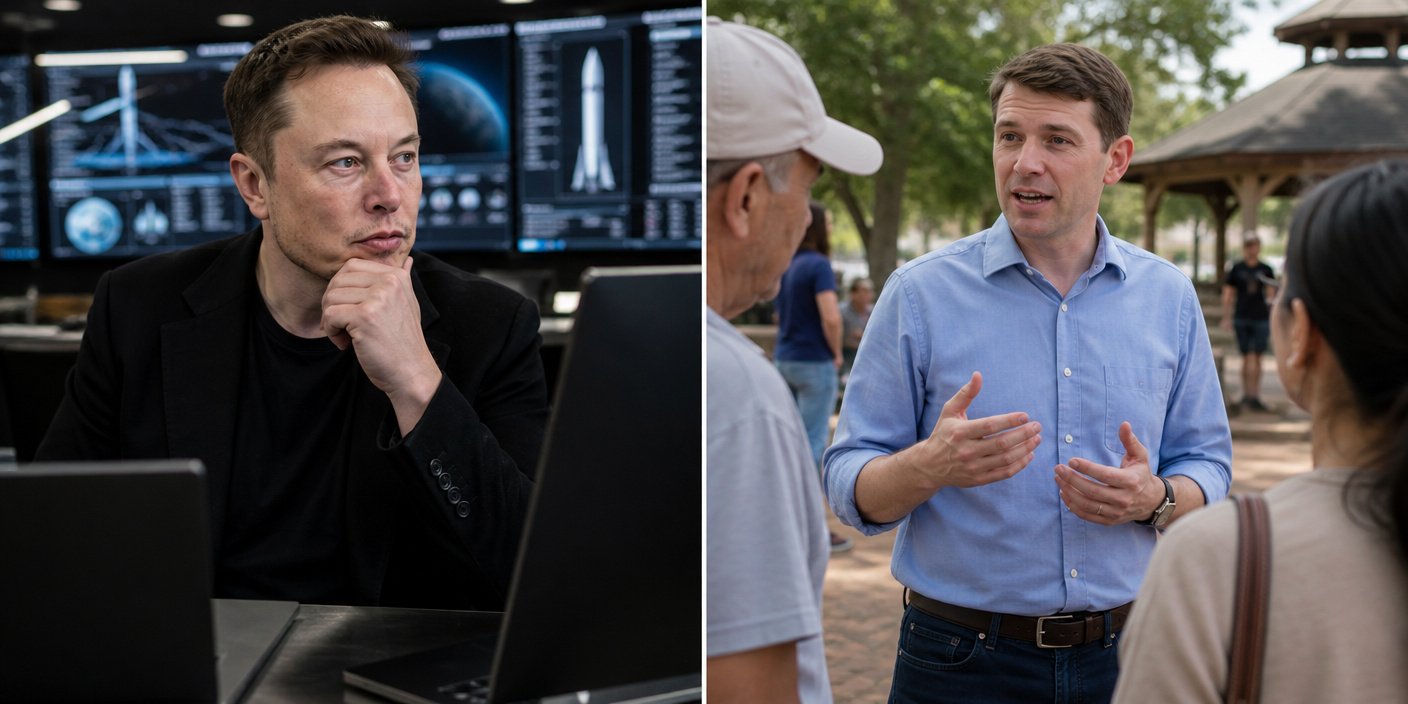
The political landscape in Texas has irrevocably shifted. In a move that signals a new era of billionaire-led electoral intervention, Elon Musk has firmly planted his flag in the Texas Senate race. The battlefield is no longer just about traditional local issues; it is a high-stakes, capital-intensive ideological proxy war. By committing over $150 million to explicitly oppose Democratic candidate James Talarico, Musk has effectively transformed this contest into a direct confrontation between the world’s wealthiest tech mogul and a rising progressive challenger. This massive financial injection does more than pad war chests—it fundamentally redefines the mechanics of campaign strategy and the influence of platform ownership in modern democratic processes.
Key Highlights
- $150 Million Intervention: Elon Musk has allocated a staggering $150 million, a sum that eclipses typical state-level Senate spending, specifically targeting the defeat of James Talarico.
- Weaponized Digital Presence: Utilizing the X (formerly Twitter) platform, Musk has pivoted from passive donor to active agitator, frequently targeting Talarico’s platform and policy stances.
- Redefining Political Spending: This move bypasses traditional PAC structures, signaling a potential trend where platform owners leverage their digital infrastructure to tip the scales in localized legislative races.
- Ideological Collision: The conflict centers on a clash between Talarico’s progressive, grassroots policy agenda and Musk’s vision of deregulated, technocratic governance.
The Billionaire vs. The Candidate: A New Political Reality
The traditional paradigm of the Texas Senate race—often defined by local constituent relations and state-level policy debates—has been obliterated. With the entrance of Elon Musk, the race has evolved into a nationalized, high-octane battle of resources and algorithms. The $150 million figure is not merely a donation; it is a signal of intent. For James Talarico, the challenge is no longer just about appealing to voters in his district; it is about navigating a digital environment where the owner of the town square is explicitly campaigning against him.
The Mechanics of the $150 Million Strategy
When a donor of Musk’s caliber directs such a significant amount of capital toward a single race, the implications are profound. This level of funding allows for near-total saturation of digital ad space, rapid-response polling, and the mobilization of massive ground operations. However, the true power lies in the integration with Musk’s ownership of X. Unlike traditional super PACs, which rely on external media buys, Musk has the ability to influence the visibility of narratives surrounding Talarico directly through the platform’s infrastructure.
Analysts are watching closely to see if this expenditure acts as a blueprint for future elections. If successful, this strategy could encourage other tech titans to leverage their assets in local and state races, essentially buying the capacity to reshape legislative bodies in their own image. The question for voters is not just who gets their vote, but who controls the narrative surrounding the candidates.
Digital Warfare: Musk’s X Strategy
Musk’s use of social media to attack Talarico’s candidacy marks a distinct departure from the behavior of political donors of the past. Typically, billionaire donors prefer the shadows of dark money groups. Musk, however, has opted for the spotlight, using his massive reach on X to amplify critiques of Talarico’s policy platform.
This creates a ‘feedback loop’ of political influence. Every post Musk makes regarding the Texas Senate race is viewed by millions globally, often trending and dominating the news cycle. For Talarico, this means fighting a two-front war: one in the local, brick-and-mortar sense of campaigning, and the other in the rapid-fire, volatile world of algorithmic perception. This digital scrutiny puts enormous pressure on Talarico’s campaign to remain disciplined while countering misinformation or attacks in real-time.
Talarico’s Resistance and The Stakes
James Talarico, known for a brand of politics rooted in progressive advocacy and public education reform, now finds himself at the center of a national media firestorm. The campaign has had to pivot rapidly, framing the race as a David vs. Goliath narrative. By positioning Musk as an out-of-state influence attempting to dictate the future of Texas, Talarico hopes to leverage a sense of local pride against the ‘billionaire takeover’ of his campaign.
This secondary angle—the tension between local control and external money—could prove to be Talarico’s most potent weapon. If he can turn the narrative toward the concept of sovereignty—that a Texas Senate seat should be won by Texans, not bought by Silicon Valley—he may bridge gaps with more moderate voters who are uneasy about the concentration of political power in the hands of a few unelected tech moguls.
Future Predictions: The End of Localized Politics?
Looking ahead, this race serves as a harbinger for the 2026 and 2028 election cycles. The democratization of information has paradoxically led to the monopolization of political influence. We are entering an era where the cost of entry for a candidate is not just the ability to raise funds, but the ability to survive the scrutiny of a platform owner who has decided to enter the fray. Whether Talarico wins or loses, the ‘Musk Effect’ has ensured that this Texas Senate race will be studied in political science departments for decades to come as the moment when state-level races truly went global.
FAQ: People Also Ask
1. Why is Elon Musk targeting James Talarico specifically?
Musk has expressed strong opposition to Talarico’s progressive policy platform, which focuses on public education and economic reform. Musk views these policies as contradictory to his vision for a deregulated, industry-friendly Texas economy.
2. Is the $150 million donation legal?
All political expenditures must adhere to the Federal Election Commission (FEC) and Texas Ethics Commission guidelines. The expenditure is channeled through organizations and political action committees that comply with current campaign finance law, though it pushes the boundaries of typical state-level funding.
3. How is the Texas Senate race impacted by this funding?
It has drastically increased the cost of the race. The saturation of ads and the intense media focus have made this one of the most expensive and closely watched state legislative races in American history, shifting focus from local issues to national, ideological battles.
4. What is Talarico’s stance on Musk’s involvement?
James Talarico has framed the involvement as an assault on the democratic process. His campaign actively highlights the spending as a ‘billionaire buying a seat,’ aiming to rally voters around the concept of local autonomy against corporate interference.