

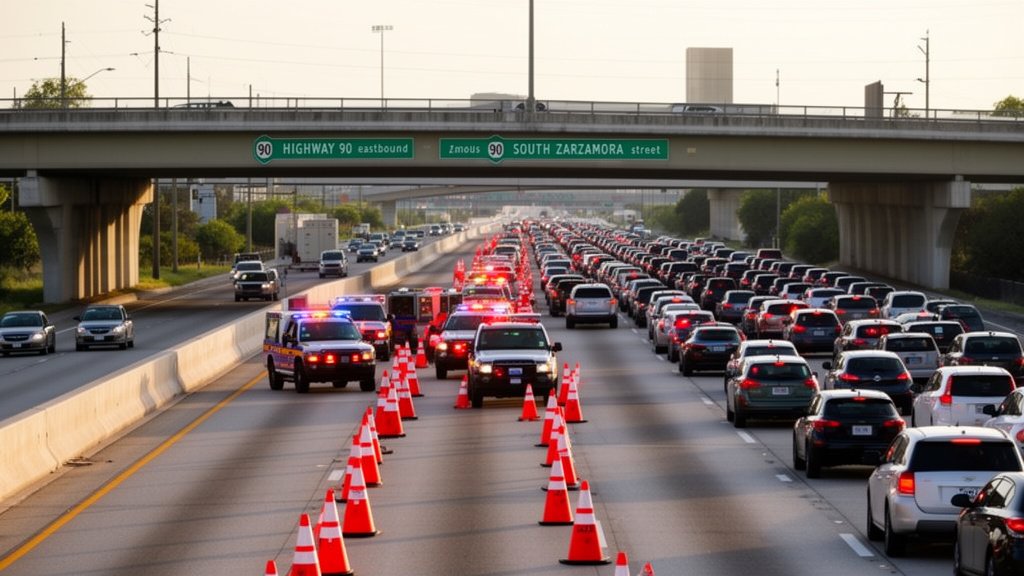
Commuters in San Antonio are facing significant delays this morning following a major traffic incident on Highway 90 West at South Zarzamora Street. The collision, which occurred during the peak rush hour, has triggered a massive, multi-lane shutdown of the eastbound carriageway, forcing local authorities to divert thousands of vehicles onto surface streets and creating a ripple effect of congestion throughout the West Side corridor. The incident, which involved multiple vehicles, has required a significant mobilization of emergency services, including the San Antonio Police Department (SAPD) and the Texas Department of Transportation (TxDOT) incident response teams.
Key Highlights
- Location Specifics: The incident is concentrated on the Highway 90 Eastbound lanes directly approaching the South Zarzamora Street overpass.
- Operational Impact: Authorities have successfully closed three lanes of traffic to facilitate emergency operations and wreckage clearance, severely limiting throughput.
- Emergency Response: SAPD and EMS crews are currently on-site managing medical logistics and investigating the crash causation.
- Traffic Advisory: Commuters are strongly urged to avoid the Highway 90 corridor and utilize alternate routes such as Culebra Road or Commerce Street to bypass the gridlock.
- Estimated Timeline: While lane clearance is underway, significant residual delays are expected to persist well into the midday hours.
Navigating the Highway 90 Crisis: Infrastructure and Incident Response
The closure of Highway 90 at South Zarzamora Street represents a critical failure point for San Antonio’s West Side infrastructure. As one of the primary arteries connecting the suburbs to the downtown business district, this specific stretch of highway is notorious for its density during morning commutes. The incident has not only blocked the flow of traffic but has also highlighted the fragility of current traffic management protocols when a major collision occurs on a high-capacity roadway.
The Immediate Aftermath and Divergence Strategy
Upon arrival, emergency responders were forced to implement a hard closure of three lanes to ensure the safety of the crash victims and the investigators processing the scene. This forced redirection of traffic into the remaining narrow channels has resulted in a cascading bottleneck. For commuters, this means that traffic is backing up as far as Loop 410, creating a “stop-and-go” environment that increases the risk of secondary “rubbernecking” collisions. TxDOT has activated overhead electronic signage to warn inbound travelers, but the sheer volume of morning traffic has rendered standard diversion routes near capacity as well.
The Role of SAPD and Forensic Investigation
In incidents involving major closures, the SAPD’s Traffic Investigations Unit (TIU) takes the lead. Their mandate is not just to clear the road, but to document the scene with forensic accuracy. This involves mapping vehicle impact points, debris fields, and potential roadway obstructions. This rigorous documentation, while essential for legal and liability purposes, significantly extends the duration of lane closures. The public must understand that the delay is not merely due to physical wreckage removal, but is also a function of the necessary investigative process required to ensure justice and liability clarity for all involved parties.
Urban Planning and the West Side Bottleneck
This crash serves as a stark reminder of the infrastructure challenges facing San Antonio. The Highway 90 corridor, characterized by older, narrower lanes and high-volume junctions like South Zarzamora, frequently struggles to accommodate the city’s rapid population growth. Urban planners have long debated the necessity of expanding arterial capacity in this region, but fiscal constraints and existing residential density make these projects notoriously difficult to execute. Today’s event is a localized example of a systemic issue: a lack of robust redundancy in the local freeway network. When a primary lane fails, the lack of immediate, high-capacity bypass alternatives means that local surface streets often become overwhelmed, putting local neighborhoods at risk of increased traffic noise, pedestrian accidents, and commercial disruption.
The Economic Ripple Effect
Beyond the frustration of delayed commutes, events like these have a measurable economic impact. Hundreds of logistics vehicles, delivery trucks, and service workers are effectively sidelined for hours. In a city like San Antonio, where the economy is heavily reliant on logistics, tourism, and services, every hour lost to gridlock translates into thousands of dollars in lost productivity. Small businesses that rely on the Zarzamora corridor for deliveries report that such shutdowns can delay operations by a full half-day, compounding the economic strain on an already sensitive local economy.
Enhancing Safety Protocols
Moving forward, the conversation shifts toward prevention. TxDOT’s ongoing “End the Streak” campaign remains the primary vehicle for public safety education in Texas. However, infrastructure experts argue that technological solutions—such as Smart Highway sensors that can alert drivers to slowing traffic miles in advance—could mitigate the severity of these crashes. Investing in intelligent transportation systems (ITS) would allow the city to manage traffic flow more dynamically, preventing the type of high-speed rear-end collisions that so often plague the Highway 90 corridor during the morning rush.
FAQ: People Also Ask
Q: How long will the lanes be closed at Highway 90 and South Zarzamora?
A: While officials have not provided a specific “all clear” time, major collision investigations and debris cleanup typically require several hours. Commuters should expect delays throughout the early afternoon.
Q: Are there any safe alternate routes around the crash site?
A: Drivers are advised to utilize Commerce Street or West Martin Street as lateral alternatives. If coming from far West San Antonio, consider taking Loop 1604 to avoid the 90/410 convergence entirely.
Q: How does this impact public transit, such as VIA Metropolitan Transit?
A: Several bus routes that utilize the Highway 90 corridor may experience significant service disruptions. Passengers should check the VIA app or website for real-time rerouting information and potential delays.
Q: Should I report real-time traffic updates while driving?
A: Safety is the priority. Do not use your phone while driving. Use apps like Waze or Google Maps to report your position and speed, which automatically contributes to real-time traffic data shared with other drivers.