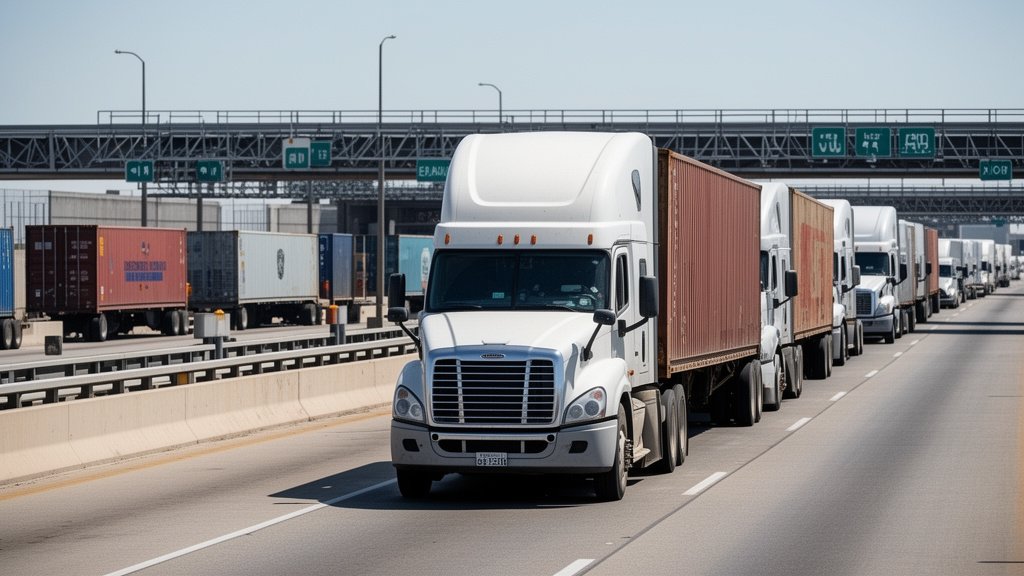
Texas is the undisputed heavyweight of American international commerce, consistently ranking as the nation’s top exporting state. With the U.S.-Mexico-Canada Agreement (USMCA) approaching its mandatory six-year review in 2026, the state’s industrial, energy, and manufacturing sectors are shifting into a defensive posture. For Texas, trade is not merely an economic metric; it is the lifeblood of the regional economy, and the looming diplomatic and regulatory uncertainty surrounding the trade pact has sparked widespread concern among business leaders across the state.
The 2026 Trade Cliff: Texas Industry on Edge
The USMCA, which replaced NAFTA in 2020, included a “sunset clause” that requires a formal review of the agreement by all three nations in 2026. While proponents of the agreement emphasize its role in stabilizing North American supply chains, Texas businesses are increasingly wary of the potential for the upcoming review to become a political lever. The state’s economy is inextricably linked to Mexico, its largest trading partner. According to recent data, Texas exports to Mexico totaled over $130 billion annually, with millions of jobs in the state supported by cross-border trade.
Businesses operating in the Texas-Mexico corridor, particularly in logistics hubs like Laredo and El Paso, are preparing for potential volatility. If negotiations falter or if political rhetoric leads to the imposition of new tariffs or stricter rules of origin, the impact on Texas companies could be swift and severe. The concern is that the six-year review will provide an opening for protectionist policies that disrupt the seamless flow of goods that Texas manufacturers rely on.
The Economic Stakes: Why Texas Stands to Lose Most
Texas serves as the primary gateway for U.S.-Mexico trade. The Laredo Port of Entry handles a significant portion of all land-based trade between the two nations, processing billions of dollars in freight monthly. For industries such as automotive manufacturing, energy, and aerospace, supply chains are deeply integrated across the border. A component may cross the border several times before reaching its final form as a finished product.
“The integration is so deep that any disruption to the USMCA is felt immediately on both sides of the Rio Grande,” noted a recent report regarding regional supply chain stability. For Texas companies, this means that even a minor tweak to trade rules—such as changes to labor value content or environmental regulations—could trigger costly reconfigurations of production processes. Energy companies, which export significant volumes of refined petroleum products and natural gas to Mexico, are particularly sensitive to any regulatory shifts that could impede their access to these critical markets.
Supply Chain Vulnerabilities and Manufacturing Fears
Beyond the immediate border logistics, the uncertainty is affecting long-term capital investment. Companies are inherently risk-averse; they prefer predictability when making decisions on where to build new plants or expand operations. The prospect of an uncertain trade landscape in 2026 creates a “wait-and-see” environment. Manufacturers are delaying large-scale expansions because they cannot accurately model the costs of future tariffs or trade barriers.
This hesitation is not theoretical. Organizations like the Texas Association of Business (TAB) have consistently emphasized the necessity of a stable trade environment for the state’s continued growth. When the rules of engagement are subject to political renegotiation, the premium on operating within Texas—a state that relies on its status as a global trade hub—increases, potentially driving investment toward more stable, albeit less strategically located, regions.
The Political Lever: Trade as a Bargaining Chip
One of the most persistent concerns is the potential for the USMCA review to be conflated with unrelated political issues, such as immigration or border security. When trade agreements become tied to political leverage, the economic consequences for border states like Texas are disproportionate. Business leaders are actively lobbying federal representatives to ensure that the 2026 review remains focused on commercial efficiency and regulatory alignment rather than becoming a proxy for broader political grievances. The challenge for Texas businesses is to maintain this distinction in an increasingly polarized political climate where trade policy is often used as a blunt instrument.
FAQ: People Also Ask
Q: Why is the 2026 USMCA review causing concern for Texas?
A: The 2026 review is a mandatory “sunset” provision of the agreement. Texas businesses fear that this renegotiation period could lead to new tariffs, tighter regulations, or supply chain disruptions, which would disproportionately hurt the state because Texas is the largest exporting state in the U.S. and relies heavily on trade with Mexico.
Q: Which sectors in Texas are most at risk?
A: The energy sector (oil and gas exports), the automotive industry (due to complex supply chains crossing the border multiple times), and logistics/transportation hubs like Laredo and El Paso are the most vulnerable to trade fluctuations.
Q: What is the main role of the USTR in this situation?
A: The Office of the United States Trade Representative (USTR) leads the negotiations for the U.S. during the USMCA review. Texas businesses are actively engaging with the USTR to advocate for stable, predictable trade terms that protect existing investments and supply chain integration.