
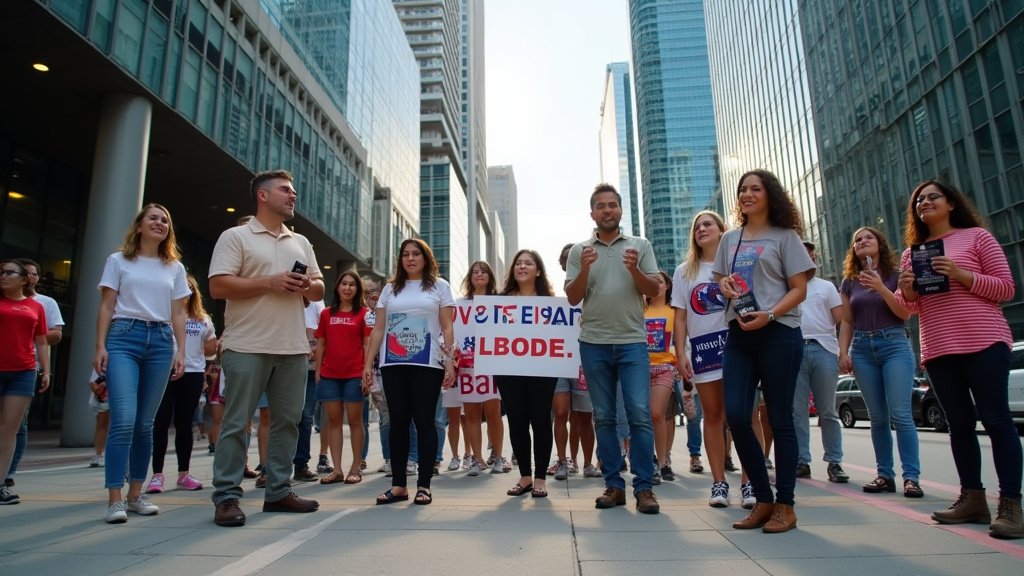
On Monday, October 19, 2026, the streets of downtown Houston became a focal point for grassroots civic engagement as demonstrators affiliated with the ‘No Kings’ movement gathered to urge citizens to participate in the upcoming midterm elections. The protest, which centered on the theme of political accountability and the power of the individual vote, arrived on the same day early voting officially commenced in Texas, highlighting a growing trend of activist groups transitioning from ideological messaging to direct voter mobilization efforts.
The ‘No Kings’ Philosophy and Civic Duty
The ‘No Kings’ movement, which has garnered attention for its anti-authoritarian stance and emphasis on distributed power, chose the commencement of the early voting period to voice their mission. By appearing in high-traffic areas of downtown Houston, the group sought to bridge the gap between abstract political criticism and concrete civic action. Organizers emphasized that while their rhetoric often critiques the centralization of government power, they believe the mechanism for correction lies within the ballot box.
For the participants, the message was clear: democracy requires active participation, and the midterm elections serve as the most direct opportunity for residents to influence local and state-level policy. The demonstrators utilized signs and public speeches to emphasize that regardless of the ideological leanings of their movement, the act of voting acts as the primary check against perceived overreach in governance.
The Strategic Timing of October 19
Choosing the first day of early voting was not a coincidence. Early voting in Texas is a critical period for political campaigns and advocacy organizations alike. Data from previous cycles suggests that a significant percentage of the total electorate casts their ballots during the early window. By launching their awareness campaign on Monday, October 19, 2026, the ‘No Kings’ protesters aimed to capture the attention of voters already inclined to engage in the process, providing a final motivational push at the very beginning of the window.
This strategy reflects a broader shift in how grassroots organizations view their impact. Rather than simply protesting policy decisions after they are made, these groups are increasingly focusing on the electoral process as the primary venue for change. The downtown Houston location allowed organizers to reach a diverse demographic of commuters, office workers, and city residents, effectively turning a standard political protest into a concentrated voter mobilization drive.
Secondary Angles: Analyzing the 2026 Political Climate
1. Harris County Electoral Impact: As the most populous county in Texas, Harris County remains the ultimate battleground for state-wide and local races. The involvement of grassroots groups like ‘No Kings’ highlights the intensity of the competition in this region. Activist groups are increasingly aware that, due to the density of the voting population, small shifts in turnout here can determine the outcome of regional elections.
2. The Evolution of Protest Tactics: Historically, protest movements often maintained distance from formal electoral politics. However, the ‘No Kings’ demonstration illustrates a merging of these spheres. This ‘electoral-activism’ hybrid suggests that groups are finding more success in integrating their demands into the voting process rather than operating solely outside of it. This marks a maturation of grassroots strategy, prioritizing systemic participation over pure dissent.
3. Early Voting Dynamics in Texas: The Texas early voting period is often touted as a vital convenience for working-class voters who may struggle to make it to the polls on election day. The focus on this period by the protesters highlights the logistical importance of early voting. Policy analysts note that the more accessible the early voting windows become, the more reliant campaigns are on ‘get-out-the-vote’ (GOTV) efforts, such as the one witnessed on October 19.
Future Implications for Voter Mobilization
As the midterm season progresses, the ‘No Kings’ protest serves as a bellwether for the upcoming weeks. If successful, this model of embedding voter encouragement into protest events could be adopted by other groups across the political spectrum. The focus is no longer just on which candidate to support, but on the existential necessity of the electoral process itself. The challenge moving forward for both sides of the aisle will be maintaining this energy throughout the early voting window and ensuring that initial enthusiasm translates into final ballot counts. While the protest was limited to a single day, its ripples are expected to be felt in local campaign offices and county election data for the remainder of the cycle.