
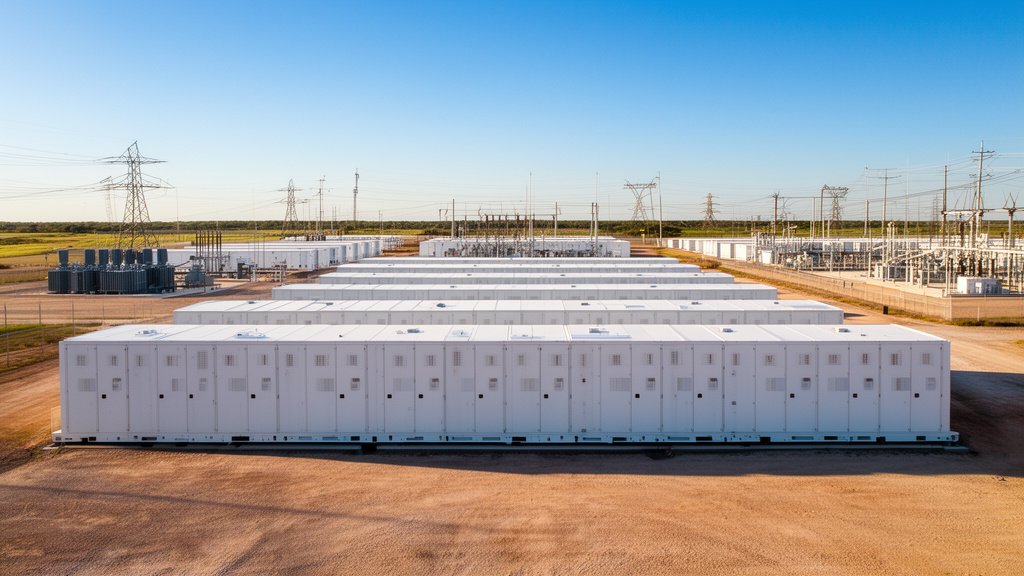
Energy Vault has cemented its position as a key player in the renewable energy market, announcing a total backlog of US$2.3 billion as of November 10, 2026, while simultaneously securing $78 million in crucial construction and bridge financing for its 150MW/300MWh SOSA Energy Centre in Madison County, Texas. This dual-action announcement marks a significant operational pivot, demonstrating the company’s ability to convert its high-value pipeline into active, capital-backed infrastructure projects.
Key Highlights
- Strategic Capital: Secured $78 million in construction and bridge financing, specifically earmarked for the SOSA Energy Centre.
- Contractual Momentum: Total backlog reached US$2.3 billion as of November 10, 2026, providing robust revenue visibility.
- Texas Expansion: The 150MW/300MWh project reinforces the company’s commitment to supporting ERCOT grid stability.
Powering the Grid: Strategic Capital and Technical Execution
The closing of $78 million in financing for the SOSA Energy Centre is more than just a capital milestone; it represents a critical step in the physical execution of Energy Vault’s battery energy storage system (BESS) strategy. By securing construction and bridge financing, the company is mitigating the liquidity risks often associated with large-scale utility projects, allowing them to advance toward operational status. The SOSA project, with a 150MW power capacity and 300MWh energy storage capability, is engineered to provide high-demand response services, helping to buffer the volatility inherent in the Texas grid.
The Anatomy of the $2.3 Billion Backlog
Understanding Energy Vault’s $2.3 billion backlog is essential for analyzing the company’s long-term health. A backlog of this magnitude represents the cumulative value of signed contracts, service agreements, and project commitments that have not yet been fully realized as revenue. In the renewable sector, this figure is a leading indicator of future cash flow. As of November 10, 2026, this $2.3 billion figure underscores a broad portfolio of projects that span beyond the Texas BESS facility, signaling that the company is successfully diversifying its footprint across various regional markets and utility-scale customers.
Texas: The Frontline of Energy Storage
The choice of Madison County, Texas, for the SOSA Energy Centre is deliberate. Texas, governed by the Electric Reliability Council of Texas (ERCOT), has become the primary laboratory for large-scale energy storage in the United States. With the rapid expansion of wind and solar assets across the state, grid congestion and frequency fluctuations have reached record highs. Energy Vault’s deployment of BESS technology acts as a vital stabilizing force. By storing excess energy during peak generation times and discharging it during periods of high demand, the SOSA facility helps stabilize energy prices and prevents curtailment—the forced shutdown of renewable energy generation when the grid cannot absorb the supply.
Financial Strategy and Future Outlook
For institutional investors and energy analysts, the successful bridge financing indicates that financial institutions are gaining confidence in the commercial viability of long-duration and utility-scale battery storage. While the company is well-known for its unique gravity-based storage solutions, the consistent execution of BESS projects shows a balanced approach to market adoption. By leveraging both its proprietary gravity technology and standard lithium-ion battery solutions, Energy Vault is tailoring its service offerings to match the immediate needs of the grid operator. This dual-pronged strategy ensures that the company remains competitive, whether a project requires the long-duration capabilities of gravity storage or the immediate discharge power of lithium-ion systems.
Looking toward the remainder of 2027 and into 2028, the company’s ability to convert this $2.3 billion backlog into completed, revenue-generating assets will be the primary metric of success. The SOSA Energy Centre acts as the template for future regional deployments. If the project proceeds on schedule, it will likely serve as a proof-of-concept for similar regional grid-stabilization projects, potentially opening doors for further financing and project approvals in other high-demand states like California and Arizona.
FAQ: People Also Ask
What is the significance of the SOSA Energy Centre’s 150MW/300MWh capacity?
This capacity allows the facility to discharge 150 megawatts of power continuously for two hours. This specific ratio is highly desirable for ERCOT’s ancillary services market, which often requires fast-frequency response and short-duration, high-power dispatch to manage grid stability.
Why is Energy Vault’s $2.3 billion backlog considered a key metric?
In renewable energy development, the backlog provides a roadmap of future revenue. It indicates that the company has secured binding agreements, meaning their technology and services are in high demand and their future financial performance is underpinned by confirmed work.
What impact does this project have on the Texas power grid (ERCOT)?
Projects like the SOSA Energy Centre help manage the intermittency of renewable energy. By storing excess power generated by Texas wind and solar assets, the facility can release that energy during peak demand times, reducing the risk of grid stress and price volatility for consumers.