
In a landmark development for U.S. border policy, Texas state authorities and federal officials have successfully finalized a 30-year agreement, formalizing the status of razor wire barriers along the Texas-Mexico border, specifically within the contentious Del Rio sector. This accord effectively suspends years of aggressive litigation and operational friction between the Texas Department of Public Safety (DPS) and the U.S. Department of Homeland Security (DHS), establishing a long-term framework for how border infrastructure is managed, maintained, and legally protected.
Key Highlights
- Long-Term Permanence: The agreement establishes a 30-year operational window, signaling a shift from temporary, reactive measures to permanent infrastructure management near Del Rio.
- Legal De-escalation: The settlement resolves multiple ongoing legal disputes between the state of Texas and the federal government regarding the authority to place barriers on the banks of the Rio Grande.
- Operational Clarity: Federal agencies, including U.S. Customs and Border Protection (CBP), have coordinated with state units to delineate clear jurisdictional responsibilities for barrier upkeep.
The Del Rio Accord: Stabilizing the Border Infrastructure
The finalization of this 30-year agreement represents one of the most significant administrative pivots in recent border history. For years, the Del Rio sector has served as a focal point for the conflict between state-level sovereignty and federal oversight. The dispute, often characterized by the repetitive cutting and reinstalling of razor wire, created a dynamic of constant instability that hampered both security operations and legal clarity. By locking in a three-decade pact, both the State of Texas and the federal government are effectively prioritizing operational continuity over the chaotic cycle of litigation.
Operational Implications for the Rio Grande
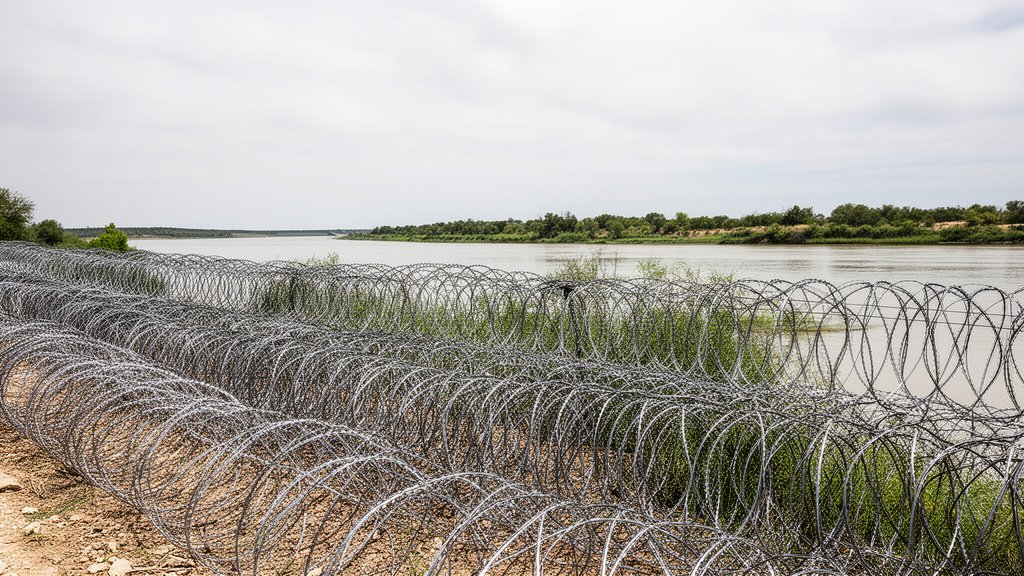
Under the new terms, the barrier infrastructure—primarily high-tension, concertina razor wire—will be permitted to remain in specific high-traffic zones identified in the agreement. This is a crucial departure from previous federal directives that characterized state-installed barriers as impediments to federal border patrol efforts. The logistics of the agreement involve detailed mapping of the riverbank, ensuring that while the wire is secured for state security interests, it does not impede the primary surveillance functions of the federal Border Patrol agents.
Logistically, this requires a level of coordination never before seen in this sector. The Texas National Guard and the Texas Department of Public Safety (DPS) are tasked with ongoing maintenance, while the federal government retains oversight of the overarching border security strategy. This division of labor is intended to reduce the operational “friction” that has historically led to standoffs between state troopers and federal agents.
Legal Precedent and Federal-State Relations
The legal significance of this 30-year agreement cannot be overstated. By codifying these barriers into a multi-decade pact, the parties are avoiding the unpredictability of federal court rulings that have fluctuated based on shifting presidential administrations and legislative priorities. This agreement creates a “safe harbor” for the infrastructure, rendering it immune to the immediate, reactionary policy shifts that occur every four to eight years.
Furthermore, this move suggests a broader maturation in the federal-state relationship. Rather than pursuing a zero-sum game in the courtroom, both entities have opted for a pragmatic framework that acknowledges the realities of current migration patterns and the political necessity of border security. For constitutional scholars, this agreement serves as an interesting case study in how states and the federal government can utilize administrative law to bypass total legislative gridlock.
Economic and Strategic Future
Beyond the headlines of security, there is an economic component to this 30-year commitment. The maintenance of thousands of linear feet of razor wire is a costly endeavor. By formalizing this as a 30-year commitment, the State of Texas can likely allocate long-term budget cycles to infrastructure maintenance, moving away from emergency procurement and towards a more planned capital expenditure model.
From a strategic standpoint, this agreement effectively “freezes” the front lines of the border conflict in Del Rio. While it does not address the broader policy questions surrounding immigration reform or asylum processing, it provides a stable environment for those on the ground. The barrier is no longer a political football subject to immediate removal, but a settled element of the border landscape. This stability allows for better resource allocation, as federal and state agencies can now focus on interdiction, intelligence gathering, and regional security rather than the cyclical dispute over the physical wire itself.
FAQ: People Also Ask
Q: Does this 30-year agreement apply to the entire Texas-Mexico border?
A: No, the agreement is specifically focused on the Del Rio sector, which has been the primary site of legal and operational disputes regarding razor wire barriers.
Q: Will this agreement prevent federal agents from removing the wire?
A: Yes, under the terms of the settlement, the federal government has agreed to allow the wire to remain in place for the duration of the 30-year term, provided it is managed in accordance with the agreed-upon security protocols.
Q: How does this impact the ongoing litigation in Texas v. DHS?
A: This agreement effectively moots or settles the specific claims regarding the razor wire in the Del Rio sector, allowing those specific cases to be closed or withdrawn.
Q: Who is responsible for the maintenance of the wire?
A: The agreement stipulates that the State of Texas, through its relevant agencies like the DPS, will oversee the installation and upkeep of the barriers, while maintaining coordination with federal CBP officials to ensure federal operations are not obstructed.