
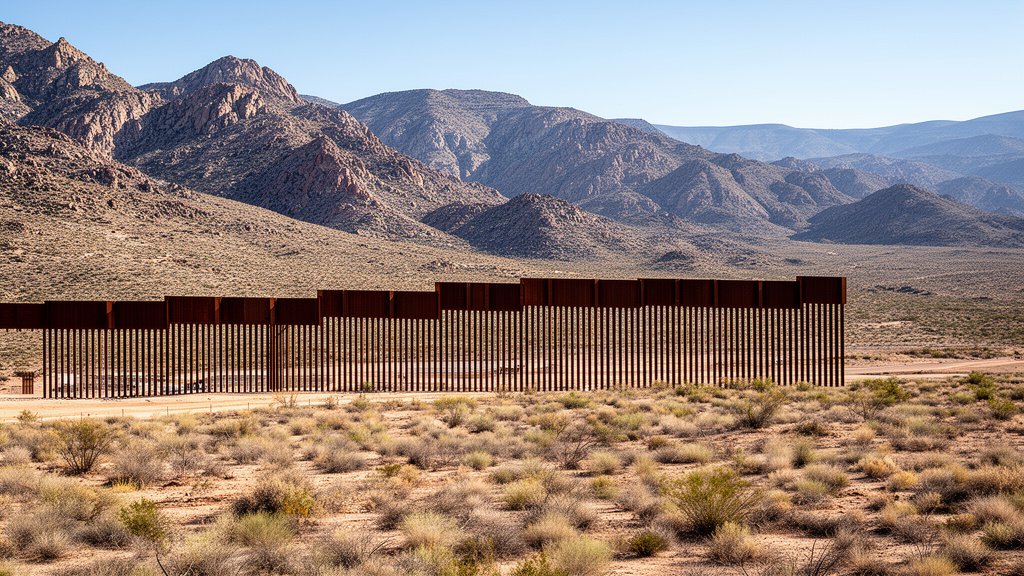
The Trump administration has issued a directive to temporarily halt construction of a contentious border wall project situated within the boundaries of Big Bend National Park. This strategic pause, confirmed by agency officials, comes as the head of the responsible department initiates a comprehensive, on-the-ground evaluation of the site to assess the feasibility and consequences of ongoing infrastructure development in one of the United States’ most geographically complex and ecologically significant protected areas.
Key Highlights
- Immediate Construction Halt: All active construction operations within the Big Bend National Park sector have been suspended indefinitely.
- Direct Oversight: The head of the responsible agency is conducting a personal on-the-ground review of the site.
- Geopolitical Conflict: The project has faced intense scrutiny regarding the balance between national security infrastructure and the preservation of National Park Service (NPS) land.
- Evaluation Mandate: The pause is intended to gather empirical data on the project’s impact, which will inform the next steps for border security initiatives in the region.
The Intersection of National Security and Conservation
The decision to pause construction in Big Bend National Park underscores the complex, often conflicting priorities facing federal agencies tasked with border security. Big Bend, renowned for its vast, rugged terrain and status as an International Dark Sky Park, presents unique engineering and environmental challenges that differentiate it from other, flatter sections of the U.S.-Mexico border.
The Engineering Challenge
Constructing a continuous border wall in this region involves not just the installation of physical barriers, but the management of massive logistical efforts in remote, high-altitude desert environments. The infrastructure requires access roads, utility support, and, in many areas, the modification of natural topography. The temporary pause allows officials to re-examine whether current construction plans adequately account for the specific geographical hurdles that define the Big Bend landscape.
Environmental and Regulatory Friction
For months, environmental groups and NPS advocates have voiced concerns regarding the potential degradation of the Rio Grande corridor, which forms the international border in this sector. The pause suggests that these concerns, alongside logistical reports from the field, have reached a point where federal leadership requires a firsthand assessment. The evaluation is expected to look beyond construction deadlines, analyzing the long-term impact on local wildlife corridors, historical artifacts, and the integrity of the park’s fragile desert ecosystem. By stepping back, the administration is allowing for a “sanity check” on a project that has historically navigated a labyrinth of regulatory and land-use hurdles.
Managing the Border Narrative
From a policy perspective, the halt reflects a recalibration of the border construction narrative. While the administration remains committed to securing the border, this pivot highlights a pragmatic approach to project management. Instead of moving forward under localized opposition and technical uncertainty, the agency is leveraging an “on-the-ground” review to validate that the deployment of resources—and the physical footprint of the wall—aligns with broader administrative goals for effectiveness and efficiency. This evaluation will likely determine whether the existing project blueprint requires significant revision or if alternative security measures might better serve the objectives without compromising the status of one of the nation’s most cherished wild spaces.
FAQ: People Also Ask
Q: Why was the Big Bend project considered particularly contentious?
A: The project faced resistance because Big Bend is a protected National Park. The construction of a massive, industrial-style wall impacts the natural, scenic, and ecological integrity of the land, leading to clashes between border security mandates and federal preservation laws.
Q: Who is responsible for the site evaluation?
A: The evaluation is being spearheaded by the head of the responsible agency, who has been dispatched to perform an on-the-ground assessment to verify current progress and potential environmental or logistical impacts.
Q: Is this pause permanent?
A: No. The administration has categorized this as a “temporary” pause. The objective is to evaluate the project’s current trajectory, not to abandon the overall goal of border infrastructure.
Q: How does this impact the broader border wall timeline?
A: While Big Bend is a significant section, it is only one part of a larger, systemic infrastructure initiative. The pause allows for a focused review of this specific, complex site without necessarily halting work across other, less sensitive sectors of the border.