
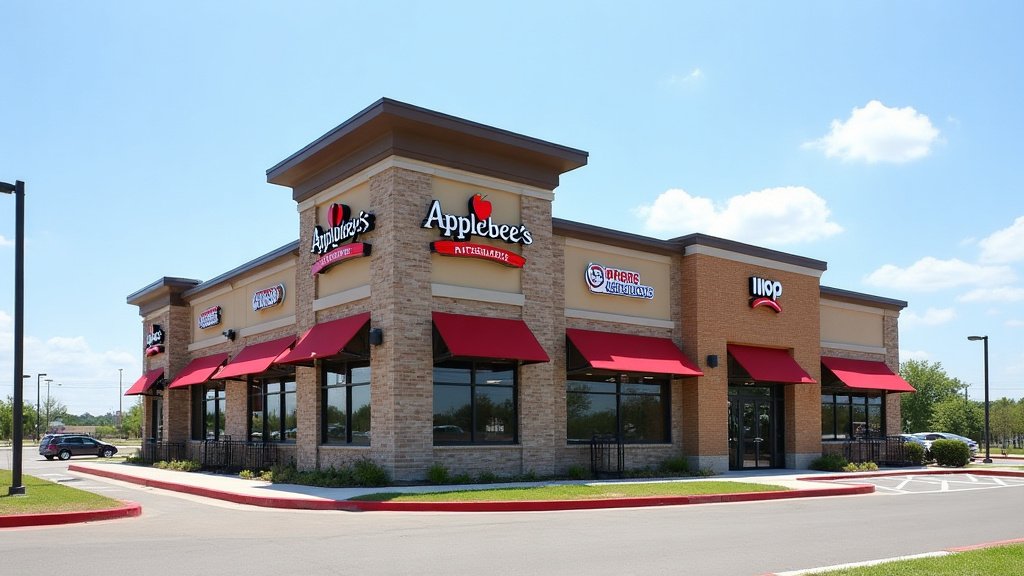
The high-traffic commercial corridor of Interstate 35 in San Marcos, Texas, is undergoing a significant transformation. The site formerly occupied by Hooters, located at 1045 North Interstate 35, is currently being converted into a dual-branded restaurant featuring both Applebee’s and IHOP. This development marks a notable change in the local dining landscape, pivoting away from the single-brand sports-bar model toward a consolidated “convenience-focused” dual-concept strategy that aims to capture a broader demographic of diners throughout the day. For residents and the influx of students from the nearby Texas State University, this represents a new anchor for casual dining in a city that continues to experience rapid population growth.
The Strategic Pivot: Dine Brands Global’s Dual-Concept Model
The move to install a dual-branded Applebee’s and IHOP is not an isolated experiment but part of a calculated strategy by Dine Brands Global. The parent company, which owns both franchises, has been aggressively testing the “dual-brand” model across the United States. By housing two distinct dining experiences under one roof, the company can maximize the utility of its real estate and operational overhead.
From an operational perspective, the synergy is clear: IHOP captures the critical morning and breakfast traffic—a market segment that standalone Applebee’s locations traditionally struggle to engage. Conversely, Applebee’s serves the lunch and dinner crowd, offering a traditional casual-dining menu that compliments the breakfast-centric offerings of IHOP. By sharing a kitchen and operational staff, Dine Brands can minimize labor costs and optimize supply chain efficiency. This “all-day” dining capability is particularly advantageous in a college town like San Marcos, where dining habits are erratic and student demand spans from early-morning study sessions to late-night post-class dinners.
San Marcos and the I-35 Economic Corridor
The San Marcos segment of the I-35 corridor is widely recognized as one of the most commercially dense areas in the Texas Innovation Corridor, situated strategically between the metropolitan hubs of Austin and San Antonio. The selection of the former Hooters site—a location with high visibility and established ingress/egress points—underscores the importance of location-based real estate acquisition in the current market. As commercial rents rise in Central Texas, legacy chains are increasingly looking to renovate existing footprints rather than undertaking expensive new “ground-up” construction projects.
This renovation project reflects a broader trend in suburban retail development: the recycling of commercial assets. Rather than allowing a high-value property to remain vacant, Dine Brands is leveraging existing plumbing, electrical, and structural frameworks to launch a modern facility. This approach not only shortens the “time to market” but also helps maintain the continuity of the commercial district, ensuring that the 1045 N I-35 address remains an active, tax-generating entity for the city of San Marcos.
Impact on Texas State University and Local Dining
For the Texas State University community, the arrival of a dual-branded IHOP and Applebee’s offers a reliable, recognizable option. While San Marcos boasts a vibrant local dining scene, there remains a persistent demand for national “comfort food” chains that offer predictable price points and familiar menus. The presence of both brands in a single location simplifies the decision-making process for groups, as the combined menu caters to a wider range of preferences without requiring multiple stops.
Industry analysts note that this development could influence local dining patterns. In a competitive college market, the convenience of a dual-branded facility often acts as a “traffic driver” for a specific intersection. If successful, this San Marcos location could serve as a blueprint for how Dine Brands manages similar assets in secondary and tertiary markets across the Southern United States. The challenge, however, will be maintaining consistent service standards across two different menus and brand identities within a single operational environment.
Future Predictions for Dual-Branding
Looking ahead, the success of this San Marcos location will likely be measured by its ability to maintain high throughput during peak hours. If the dual-brand model effectively captures the “day-part” transition—seamlessly switching from breakfast traffic to dinner demand—it is highly probable that we will see further consolidation of legacy casual-dining brands. This shift indicates a departure from the “niche” dining experience to a “comprehensive” dining experience, where accessibility and efficiency are valued as highly as the food quality itself. As consumers continue to demand flexibility and value, the “two-in-one” restaurant model appears poised to become a staple of American suburban dining.