
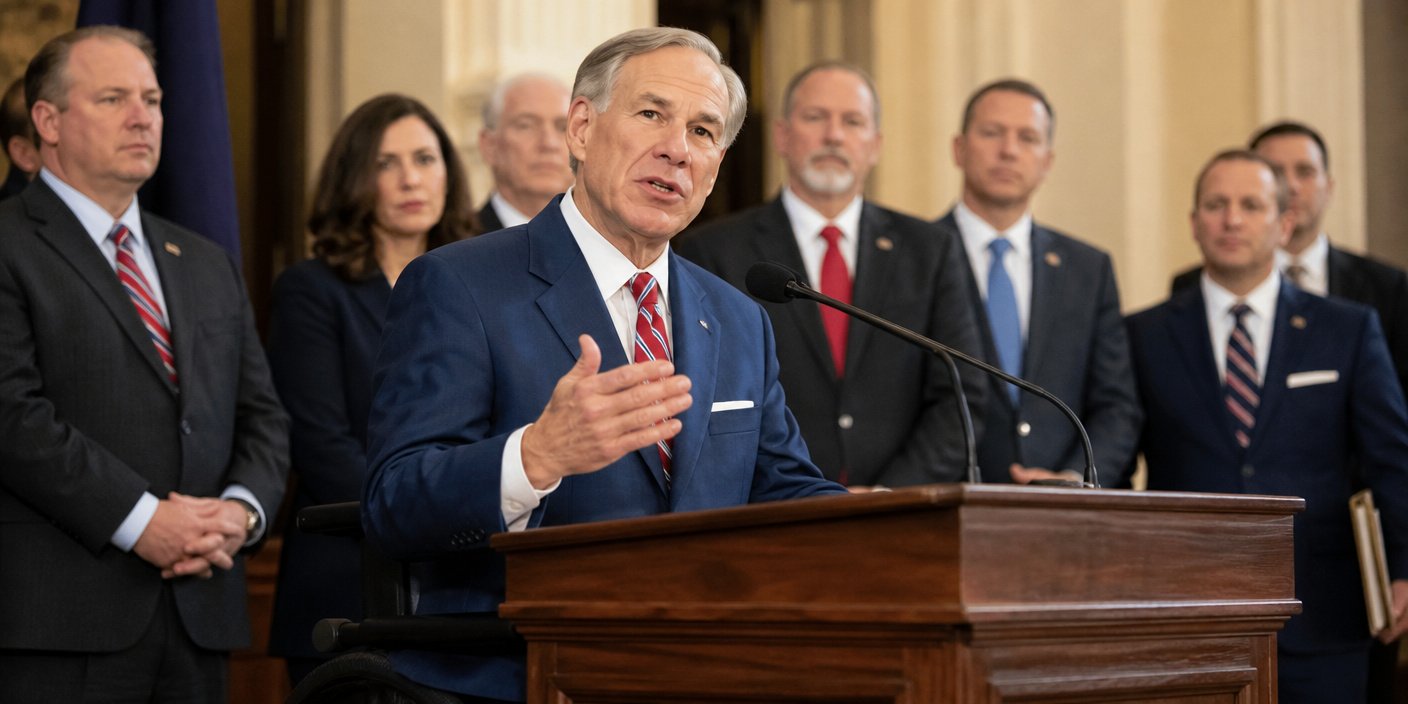
Governor Greg Abbott has issued a high-priority directive to the Texas Commission on Environmental Quality (TCEQ) to immediately cease the issuance of permits for new data center projects across the state. This administrative pause is designed to create a window for a comprehensive audit conducted by the Electric Reliability Council of Texas (ERCOT) and the Texas Water Development Board. The directive reflects a growing tension between Texas’s position as a premier hub for AI and cryptocurrency infrastructure and the physical realities of the state’s energy grid and water supply systems.
Key Highlights
- Regulatory Pause: Governor Abbott has mandated a temporary halt on all new TCEQ data center permits.
- Multi-Agency Audit: ERCOT and the Texas Water Development Board will evaluate the collective impact of current and future data center projects.
- Grid Stability Focus: The order aims to prevent capacity bottlenecks during peak demand periods on the Texas power grid.
- Water Security: The audit will scrutinize the significant water consumption required by modern liquid-cooled high-density computing clusters.
Rethinking the Digital Frontier: The Regulatory Audit of Texas Data Infrastructure
The explosive growth of high-performance computing in Texas has hit a significant bureaucratic speed bump. Governor Abbott’s decision to halt Texas data center permits represents a pivotal shift in state policy, moving from an era of unchecked, rapid expansion to one of strategic resource management. This directive is not merely an administrative hurdle; it is a calculated response to the reality that the digital revolution requires heavy physical infrastructure that the current Texas utility landscape is struggling to accommodate.
The Convergence of Energy and Computation
The fundamental issue driving this audit is the massive, non-linear increase in power demand. Modern data centers, particularly those housing GPU clusters for Artificial Intelligence (AI) training and large-scale cryptocurrency mining, operate 24/7 with a power density far exceeding that of traditional industrial facilities. When these centers cluster in specific Texas regions—often leveraging tax incentives and low land costs—they create concentrated “load pockets” that stress local distribution lines and regional transmission hubs.
ERCOT’s involvement in this audit is critical. As the manager of the Texas electrical grid, ERCOT has voiced concerns about maintaining reliability during extreme weather events. The audit will likely focus on “firm load” requirements, potentially mandating that data center operators contribute more directly to grid capacity or demand response programs rather than simply pulling from the shared pool.
The Unseen Cost: Water Consumption
While energy usage captures most of the public discourse, water consumption is becoming an equally pressing secondary concern. High-density server farms often employ evaporative cooling systems, which require substantial volumes of water to prevent hardware failure. In a state where water rights and aquifer management are highly sensitive political topics, the Texas Water Development Board’s (TWDB) participation in this audit signals that the state is prepared to treat water as a constrained, strategic asset alongside electricity.
For developers, this implies that the “permits as usual” era may be coming to an end. Future projects will likely be required to demonstrate closed-loop cooling capabilities, water recycling efficiencies, or provide proof of water-neutral operations before breaking ground.
Implications for the Texas Economic Model
Texas has successfully marketed itself as a low-regulation environment, a strategy that has lured massive tech investment. This directive creates a unique challenge for the state’s economic development agencies. If the audit leads to more stringent requirements, Texas must balance the need to preserve its “open for business” reputation with the pragmatic necessity of keeping the lights on and the water running for its residents.
Industry analysts are already speculating on the secondary effects of this pause. We may see a market consolidation, where only the largest, most well-capitalized tech firms with the resources to build private grid-support infrastructure can afford the regulatory hurdles. Conversely, smaller players may be forced to look toward states with higher existing grid redundancy. This could lead to a ‘flight to quality,’ where data centers are incentivized to relocate to areas of the state with existing, underutilized generation capacity, effectively using the audit to optimize the state’s industrial map.
FAQ: People Also Ask
Q: How long will the data center permit pause last?
A: While the Governor’s office has not provided a specific “sunset” date for the audit, industry experts anticipate a duration of several months. The audit requires complex modeling from both ERCOT and the TWDB, suggesting that the freeze will persist until the agencies present a framework for sustainable permitting.
Q: Will this affect data centers currently under construction?
A: Generally, regulatory freezes of this nature apply to new permit applications. Projects that have already secured their TCEQ permits and are currently under construction are typically grandfathered in, though they may face new operational oversight or reporting requirements once they go online.
Q: What is the primary concern for the Texas Water Development Board?
A: The primary concern is the cumulative impact of evaporative cooling systems on the state’s water supply. As more data centers are built, the aggregate volume of water diverted from municipal or agricultural use to cool servers poses a significant long-term resource management challenge.
Q: Is this a permanent ban on data center construction?
A: No. This is a temporary audit aimed at creating a new permitting structure. The goal is not to stop the growth of the technology sector, but to ensure that the physical infrastructure—the grid and water supplies—can sustain the projected load without compromising services for Texans.