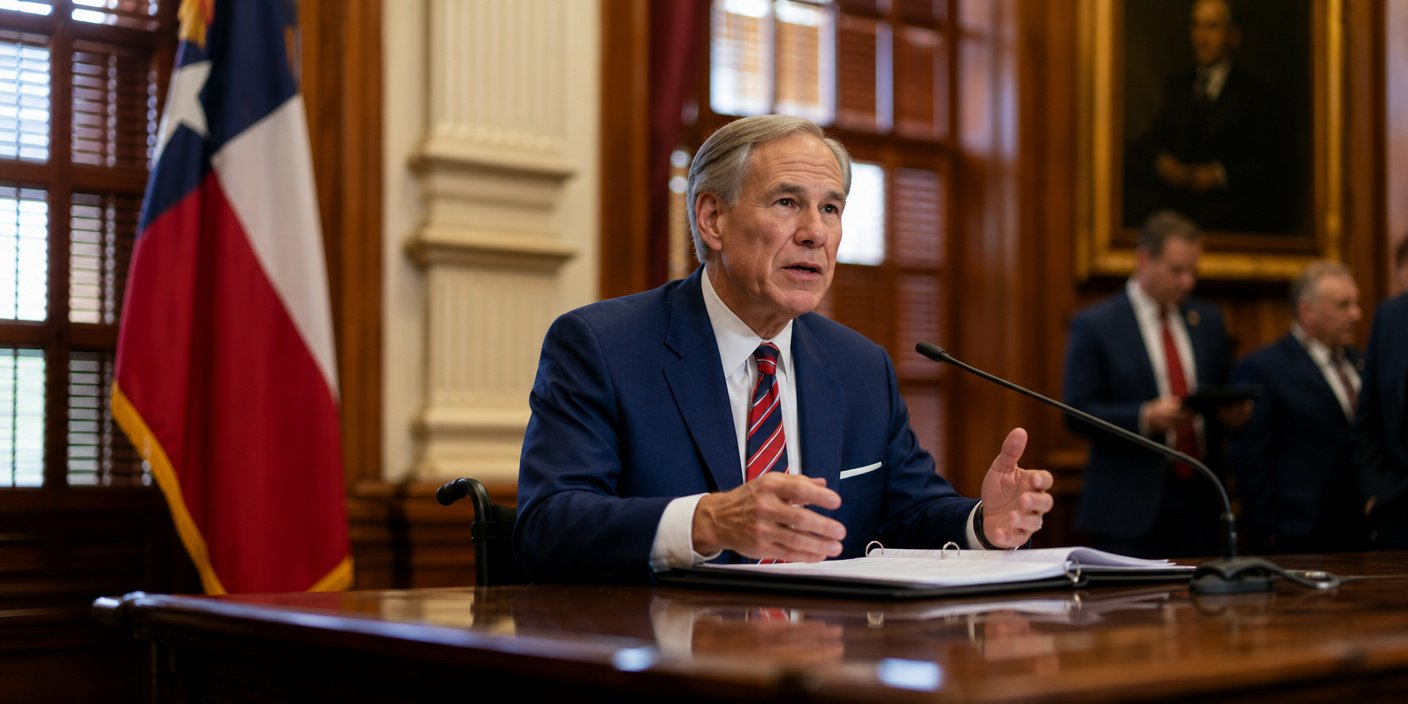
Texas Governor Greg Abbott has intensified his administration’s focus on immigration and state sovereignty, announcing a controversial initiative to prohibit public schools in Texas from utilizing H-1B visas to hire international educators. The move, framed by the Governor’s office as a critical step toward eliminating foreign influence within the state’s education system, has immediately sparked a firestorm of debate among school administrators, teacher unions, and policymakers. While the administration argues that the policy protects the state’s interests, school districts—particularly those struggling to fill high-demand vacancies—are warning that the decision could exacerbate a pre-existing teacher shortage, specifically in STEM and foreign language subjects.
Key Highlights
- The Directive: Governor Abbott has moved to limit the use of H-1B visa holders in Texas public schools, citing concerns over foreign influence and state-level control over education.
- The Rationale: The administration argues that international influence in the classroom must be curtailed to ensure Texas students are taught by individuals aligned with state values and security interests.
- Staffing Crisis: Opponents argue the ban ignores the reality of teacher shortages, particularly in critical subject areas like high-level mathematics, physics, and world languages.
- Administrative Impact: School districts are now assessing how this directive will disrupt recruitment pipelines, as international educators often fill gaps that domestic recruitment efforts cannot cover.
The Clash Between Policy and Classroom Reality
At the heart of the debate is the tension between Governor Abbott’s prioritization of ideological security and the operational necessities of the Texas Education Agency (TEA). For years, Texas, like much of the United States, has faced a chronic teacher shortage. This deficit is not evenly distributed; it is most acute in specific, high-specialization fields. When domestic recruitment pools fail to yield qualified candidates for AP Calculus, Physics, or specialized dual-language programs, districts have historically turned to federal immigration pathways—specifically the H-1B program—to recruit qualified educators from abroad.
The Security Argument: Defining “Foreign Influence”
The rationale behind Governor Abbott’s push to ban these visas is rooted in a broader political movement in Texas to assert state-level authority over various federal-influenced systems. The administration posits that allowing foreign nationals to occupy teaching positions facilitates a form of soft power or ideological influence that Texas policymakers seek to minimize. The argument relies on the premise that the classroom is a foundational element of civic identity, and therefore, the state has a compelling interest in ensuring that educators are domestic actors. This position is part of a larger, ongoing effort by the Abbott administration to challenge federal oversight and implement stricter state-level controls on immigration and institutional hiring practices.
The Operational Reality: Why Schools Rely on H-1B
School districts in Texas rarely choose the H-1B route lightly. It is a time-consuming, expensive, and legally complex process. Recruiting a teacher via an H-1B visa requires the district to prove that the candidate possesses specialized knowledge that is unavailable domestically. This is not a mechanism for hiring general classroom teachers; it is a specialized tool used primarily for high-demand, hard-to-staff roles. In many Texas districts, the choice is often between a classroom led by an H-1B certified specialist or a classroom led by a long-term substitute or an under-qualified teacher. For administrators, the primary objective is instructional continuity—ensuring that students have access to rigorous coursework, such as advanced mathematics and science, which are essential for college and career readiness.
The Impact on Critical Subjects
The prohibition, if implemented, will disproportionately affect school districts that serve diverse populations or those located in areas where domestic teacher recruitment is already difficult. Specifically, programs dedicated to bilingual education and advanced STEM curriculum are heavily reliant on international talent. These teachers often bring unique pedagogical approaches and subject-matter expertise that are difficult to cultivate locally. By removing this recruitment avenue, the state risks a reduction in the quality and availability of these essential courses, potentially widening the achievement gap between districts with the resources to recruit domestically and those that have historically used international hiring to bridge the staffing divide.
Secondary Angle: The Economic and Academic Cost
Beyond the political discourse, there is an economic reality that critics are quick to point out: the cost of attrition and the failure to fill positions. When a teacher position remains vacant, the school district loses efficiency. It may be forced to merge classes, increasing the student-to-teacher ratio, or cancel specialized programs altogether. Furthermore, the reliance on international teachers is not a permanent state but often a stop-gap measure. Critics suggest that banning these visas without a corresponding, robust plan to bolster domestic teacher training and retention effectively punishes the students, not the federal government or the international entities the Governor aims to restrict.
FAQ: People Also Ask
1. What is an H-1B visa in the context of teaching?
An H-1B visa is a non-immigrant visa that allows U.S. employers to hire foreign workers in specialty occupations that require theoretical or technical expertise. In education, it is used by school districts to hire teachers for subjects where there is a documented domestic labor shortage, such as STEM or foreign languages.
2. Can Governor Abbott legally ban these visas?
While the H-1B program is a federal immigration pathway governed by the U.S. Citizenship and Immigration Services (USCIS), state governments can regulate their public institutions. The legal battleground will likely focus on whether the state can restrict its own agencies and school districts from participating in a federally sanctioned program.
3. Why are schools against this ban?
Many school districts oppose the ban because they fear it will exacerbate existing teacher shortages. Administrators argue that in fields like math and science, where qualified applicants are rare, the H-1B program serves as a critical safety net to ensure students have access to high-quality instruction.