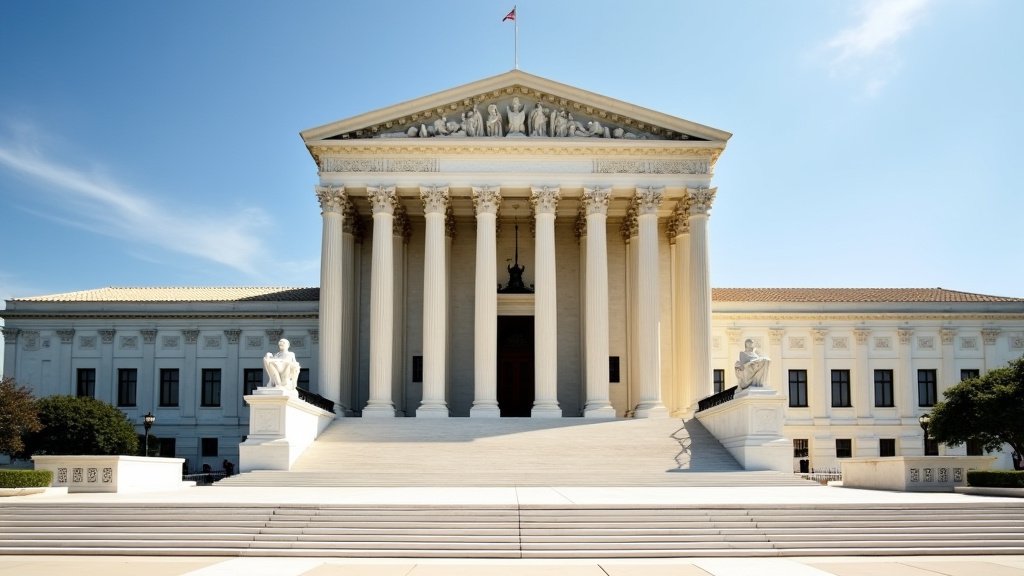


Texas executed James Broadnax on Tuesday evening after the Supreme Court rejected his final appeal. The appeal was based on new evidence that his cousin confessed to the murder for which Broadnax was convicted.
Key Highlights:
- James Broadnax was executed by lethal injection in Texas.
- His final appeal to the Supreme Court was denied.
- The appeal centered on a confession from his cousin implicating himself in the crime.
- Broadnax maintained his innocence throughout the legal process.
- The execution proceeded after the Supreme Court’s decision.
The Final Hours of James Broadnax
The Supreme Court’s Decision
The United States Supreme Court has once again become the final arbiter in capital punishment cases, and on Tuesday, it rendered a decision that sealed the fate of James Broadnax. The court rejected a last-ditch appeal that sought to halt his execution, which was scheduled for Wednesday. The appeal was built upon a foundation of newly surfaced evidence: a confession from Broadnax’s cousin, who claimed sole responsibility for the murder that led to Broadnax’s conviction and death sentence.
This confession, made years after the initial trial, introduced a complex layer of doubt into a case that had long been considered settled by Texas state courts. Broadnax’s legal team argued passionately that this new information warranted a thorough review and, at the very least, a stay of execution to allow for further investigation and potential retrial. The core of their argument hinged on the principle of justice and the irrefutable notion that an innocent person should not be put to death.
However, the Supreme Court, in its typical concise manner, did not elaborate on the specific reasons for its denial. This lack of detailed explanation leaves Broadnax’s legal team and advocates for criminal justice reform frustrated, questioning the Court’s threshold for intervention in capital cases, especially when credible claims of innocence emerge late in the process. The denial signifies that, in the eyes of the highest court, the evidence presented did not meet the bar required to overturn the state’s conviction and sentence.
The Crime and Conviction
James Broadnax was convicted in 2002 for the 1999 murder of Domanic Brown. The prosecution’s case relied heavily on circumstantial evidence and witness testimony, painting a picture of Broadnax as the perpetrator. Despite the conviction, Broadnax has consistently maintained his innocence, a plea that has echoed through the appeals process for over two decades. The emergence of his cousin’s confession, however, has cast a long shadow over the original proceedings.
According to reports, the cousin, who has not been publicly identified in all accounts of the case, allegedly confessed to a third party that he, and not Broadnax, was responsible for Brown’s death. This confession, while powerful, faced significant hurdles in being admitted as substantive evidence in the appeals. Legal standards often require more than an out-of-court statement, especially years after the fact, demanding corroborating evidence or proof that the confession is reliable and verifiable.
Broadnax’s legal team worked tirelessly to authenticate this confession, seeking to present it to the courts as newly discovered evidence that would fundamentally alter the understanding of the crime. They argued that the confession, coupled with perceived weaknesses in the original prosecution’s case, presented a compelling argument for a new trial. The gravity of the situation was amplified by the imminent execution date, adding a race-against-time element to their legal strategy.
The Broader Implications of Capital Punishment
The case of James Broadnax is a stark reminder of the ongoing debate surrounding capital punishment in the United States. Proponents of the death penalty often cite deterrence and retribution as key justifications, while opponents highlight the risk of executing innocent individuals, the potential for racial bias in its application, and the moral implications of state-sanctioned killing.
This particular case brings the issue of wrongful convictions and the effectiveness of the appeals process into sharp focus. When new evidence, such as a confession from another party, surfaces, it raises critical questions about the finality of judicial decisions and the safeguards in place to prevent irreversible errors. The Innocence Project and other organizations advocating for criminal justice reform often point to cases like Broadnax’s as examples of systemic flaws that need addressing.
Furthermore, the role of the Supreme Court in reviewing capital cases is under constant scrutiny. Critics argue that the Court often denies certiorari, leaving lower court decisions and state-level capital punishment practices largely unchecked. This can lead to disparities in justice across different jurisdictions and a perception that the ultimate punishment is applied inconsistently.
The Execution and its Aftermath
Following the Supreme Court’s denial of the appeal, all legal avenues for Broadnax were exhausted. Texas, a state with one of the highest rates of execution in the country, proceeded with the scheduled lethal injection. The execution marks the end of a long and arduous legal battle, one that has been closely watched by those involved in the capital punishment discourse.
The execution of James Broadnax, like all capital punishments, is expected to reignite discussions about the death penalty’s fairness, efficacy, and morality. His story serves as a somber case study in the complexities of the justice system, the finality of its judgments, and the enduring quest for truth and accountability in the face of ultimate consequences.
FAQ: People Also Ask
What is the primary reason for James Broadnax’s final appeal?
James Broadnax’s final appeal was primarily based on new evidence: a confession from his cousin who claimed responsibility for the murder of Domanic Brown, for which Broadnax was convicted.
When was James Broadnax convicted of murder?
James Broadnax was convicted in 2002 for the 1999 murder of Domanic Brown.
What role did the Supreme Court play in James Broadnax’s case?
The Supreme Court rejected James Broadnax’s final appeal, which sought to halt his execution. This denial meant that all legal avenues for him were exhausted, allowing the execution to proceed.
What is the significance of a cousin’s confession in a capital case?
A cousin’s confession, if deemed credible and substantiated by corroborating evidence, can be significant as newly discovered evidence that could lead to a new trial or a reversal of conviction. However, legal standards for admitting such evidence, especially years after the original trial, are often stringent.
What is the current status of capital punishment in Texas?
Texas is one of the states in the U.S. that actively carries out the death penalty and has one of the highest execution rates in the country. The state’s justice system continues to utilize capital punishment for certain severe crimes.