
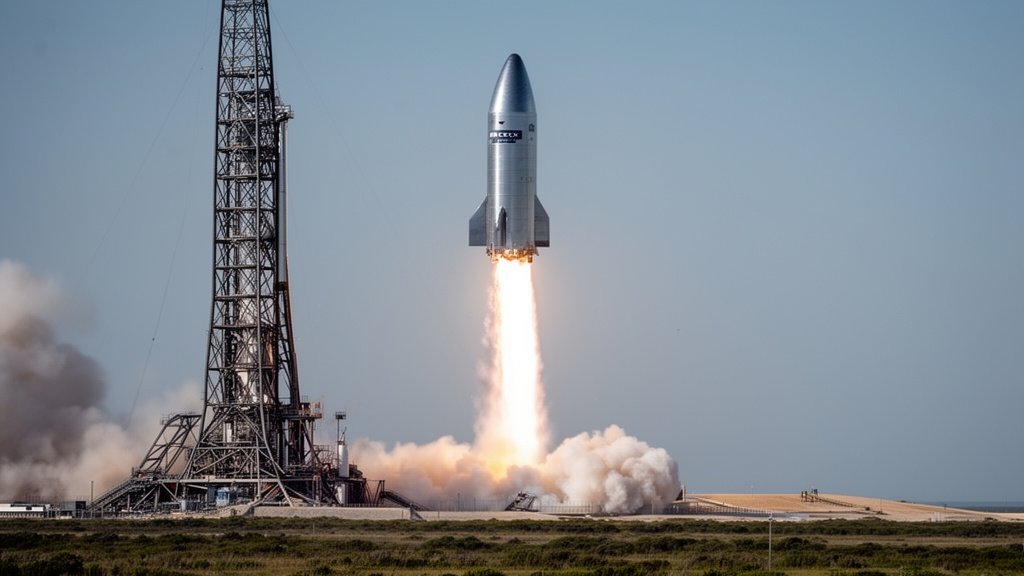
On November 13, 2026, the global aerospace community focused its eyes on Starbase, Texas, as SpaceX launched Starship Flight 15. The mission, designed to push the boundaries of rapid reusability and heavy-lift capacity, served as a crucial data point for the ongoing development of the world’s most powerful launch vehicle. While the mission was marked by a significant achievement in satellite deployment, it also highlighted the technical volatility inherent in SpaceX’s ambitious goal to bring Starship back to South Texas via a mechanical tower catch.
The Mechanics of the Mission
The launch sequence began with the ignition of the Super Heavy booster’s Raptor engines, propelling the stack from the Starbase launch facility. For the first stage of flight, the mission proceeded nominally. However, as the Super Heavy booster approached its descent phase, telemetry and visual confirmation indicated that the vehicle had deviated from the precise trajectory required for a “chopstick” catch by the launch tower. Instead of entering the arms of the Mechazilla structure, flight controllers executed a contingency maneuver, steering the booster toward an offshore splashdown. This controlled ocean landing ensured the safety of the launch infrastructure while allowing engineers to collect critical post-flight data from the booster’s final moments.
Despite the deviation in the recovery sequence, the upper-stage Starship vehicle performed flawlessly. It successfully completed its orbital insertion, positioning itself to execute its primary payload mission. Once stable in orbit, the spacecraft performed a precision deployment of 26 Starlink satellites, further expanding the capacity of SpaceX’s global internet constellation. This success underscores the dual-nature of the mission: while the recovery system continues to face iterative refinement, the payload delivery system is demonstrating consistent, high-utility operational maturity.
Analyzing the Super Heavy Divergence
The decision to divert the Super Heavy booster to an offshore splashdown is a testament to the rigorous safety protocols integrated into the SpaceX flight operations team. In the aerospace sector, the priority remains protecting launch assets and human life above all else. When automated systems detect a deviation from the tight tolerances required for a mechanical tower catch, the flight software automatically pivots to a safe-mode landing profile.
Engineers at Starbase are currently analyzing the flight telemetry to identify the specific variables—ranging from atmospheric wind sheer to potential variances in Raptor engine thrust vectoring—that led to the divergence. This is the nature of “rapid iteration” development; every non-nominal event provides the granular data necessary to tune the guidance, navigation, and control algorithms for future flights. The offshore landing proves that the hardware is capable of controlled flight even when the primary capture objective is compromised, a significant win for overall system reliability.
Starlink Expansion and Orbital Utility
The deployment of 26 Starlink satellites on Flight 15 is not merely a logistical milestone; it represents the primary commercial driver of the Starship program. As SpaceX looks toward the future, the ability to launch large batches of Starlink units into orbit at a reduced cost-per-kilogram is the bedrock of their long-term economic model. The seamless execution of the orbital phase confirms that Starship is evolving from a test article into a reliable workhorse for orbital logistics. By automating the deployment, SpaceX reduces the lead time between launch and constellation integration, ensuring that the network’s density grows in lockstep with user demand.
Future Outlook: Iteration and Rapid Reusability
Looking beyond Flight 15, the trajectory for the Starship program is clear. SpaceX is expected to maintain its aggressive testing cadence. The failure to “catch” the booster on this specific attempt will likely delay the implementation of high-frequency flight schedules by only a narrow window. The core engineering philosophy at Starbase focuses on the “learning loop.” With every launch, the software becomes more robust, and the hardware becomes more battle-hardened. The shift from experimental “hop” tests to high-mass orbital missions with secondary payload deployment signals that the technology has effectively matured to an industrial phase.
Economic and Technological Footprint at Starbase
The continuous development of the Starship launch system has transformed the regional economy of South Texas. The site has evolved from a remote testing facility into a major aerospace hub. This growth has attracted significant engineering talent, revitalized regional infrastructure, and spurred ancillary investment in the surrounding areas. The ongoing presence of Starship test campaigns brings a level of technological intensity that is rare outside of established centers like Cape Canaveral or the Kennedy Space Center.
Regulatory and Safety Thresholds
As the Starship program gains momentum, regulatory scrutiny naturally intensifies. The transition from testing to operational status requires rigorous alignment with the Federal Aviation Administration (FAA) and environmental agencies. Each mission, including Flight 15, undergoes a comprehensive review process. SpaceX’s ability to conduct these missions—even when recovery outcomes vary—highlights a high degree of transparency and data sharing with regulators. This collaborative approach is vital for the long-term sustainability of frequent orbital launches from a civilian-adjacent launch site.
FAQ: People Also Ask
Did the Super Heavy booster catch attempt succeed?
No, the Super Heavy booster did not land at the launch tower. Due to a deviation in the flight profile, the vehicle performed a controlled splashdown in the ocean instead.
How many satellites were successfully deployed?
SpaceX confirmed the successful deployment of 26 Starlink satellites during the mission’s orbital phase.
Was the Starship upper stage successful?
Yes, the upper-stage spacecraft performed nominally, reaching orbit and successfully completing its primary objective of satellite deployment.
Why does SpaceX perform a catch instead of a traditional landing?
Catching the booster with the launch tower arms allows SpaceX to rapidly refurbish and relaunch the vehicle. It eliminates the need for heavy landing legs on the booster, saving weight and simplifying the ground infrastructure required for post-flight processing.