

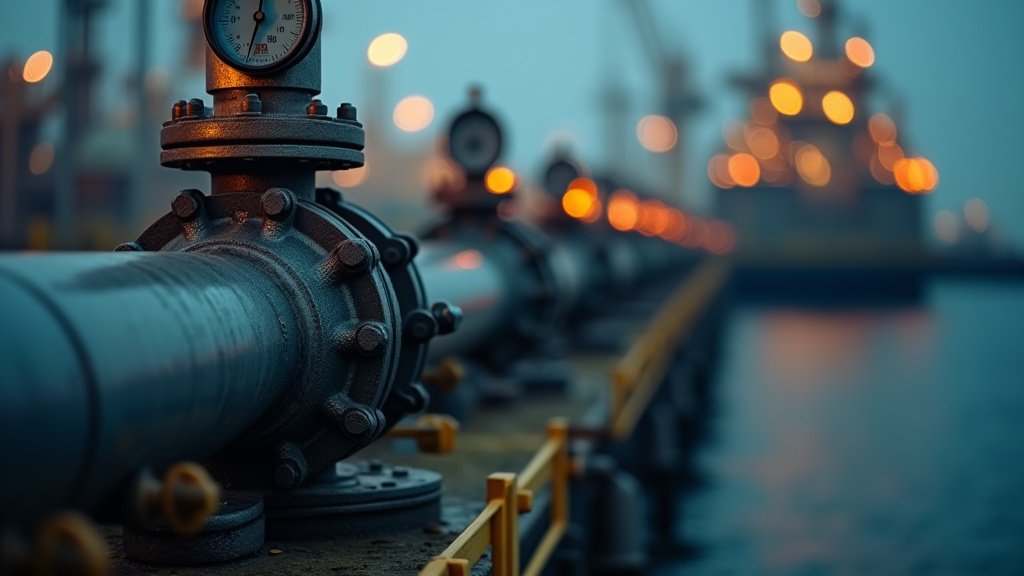
The Golden Pass LNG terminal, a colossal joint venture between ExxonMobil and QatarEnergy, continues to be a focal point of the American energy landscape as it pushes toward its long-awaited operational debut. While industry watchers and global energy markets have been bracing for the arrival of its inaugural export cargo, the project remains at the center of a complex construction and regulatory saga that underscores the massive logistical challenges inherent in building the United States’ next generation of liquefied natural gas (LNG) infrastructure. Situated in Sabine Pass, Texas, the facility represents one of the largest infrastructure investments in the state, promising to reshape the dynamics of global natural gas distribution at a time when energy security has become a cornerstone of international policy.
Key Highlights
- Joint Venture Powerhouse: A strategic partnership between global energy giants ExxonMobil and QatarEnergy, leveraging deep-water access in the Sabine-Neches Waterway.
- Market Impact: Once fully operational, the facility is expected to add significant liquefaction capacity, crucial for meeting surging demand in Europe and Asia.
- Construction & Timeline: The project has navigated complex engineering, workforce, and supply chain headwinds common to large-scale LNG terminal development.
- Geopolitical Significance: The facility serves as a critical asset in the U.S. strategy to provide energy stability to allies, particularly as global reliance on traditional pipeline gas shifts toward modular LNG shipments.
Navigating the Frontier of Gulf Coast LNG Infrastructure
The story of Golden Pass LNG is not merely one of steel and concrete, but a deep exploration of the logistical, regulatory, and market forces that dictate the flow of energy in the 21st century. As the world transitions toward cleaner-burning fossil fuels to bridge the gap in the energy transition, the Gulf Coast has emerged as the global command center for natural gas exports. Golden Pass, located in the heart of Texas’s industrial corridor, is a marquee asset in this broader economic narrative.
The Engineering Marvel in Sabine Pass
At its core, Golden Pass is an engineering feat of immense scale. Converting a former import terminal into a liquefaction and export hub required a fundamental restructuring of existing assets. The project involves the construction of three major liquefaction trains, each designed to process feed gas into high-value LNG. The technical complexity cannot be overstated; it requires massive cryogenic storage tanks, complex refrigeration cycles, and miles of specialized piping that must operate under extreme pressures and temperatures.
However, the path to the first export cargo has been anything but linear. The scale of the construction effort—which involves thousands of workers and complex sub-contracting chains—means that any hiccup in supply lines or labor availability has ripple effects. Unlike smaller infrastructure projects, an LNG terminal of this magnitude is a ‘megaproject’ where the margin for error is razor-thin, and the regulatory oversight is rigorous. The Federal Energy Regulatory Commission (FERC) maintains strict safety and environmental standards, ensuring that every weld and valve meets the highest safety codes before the facility is authorized to chill and ship its first load of product.
Economic Implications for Texas and Beyond
For the local Texas economy, Golden Pass represents a massive infusion of capital and job creation. The site has been a beacon of industrial activity, drawing labor from across the country. Beyond the construction phase, the terminal is projected to generate sustained economic benefits, including tax revenues for the local government, demand for support services, and the creation of high-skilled operational roles.
On a national scale, the project is a linchpin for U.S. export capacity. As the U.S. became the world’s leading LNG exporter, terminals like Golden Pass are essential to maintaining that lead. By providing an outlet for Permian Basin and Haynesville Shale gas, the facility prevents bottlenecks in domestic supply, keeping local prices stable while capturing international price premiums. It creates a closed loop: American producers have a steady customer, and the global market receives a reliable supply of energy that is less prone to the political volatility of pipeline-dependent regions.
Navigating Global Geopolitics
Energy security is the silent partner in every LNG deal. The demand for U.S. LNG is not just a commercial trend; it is a geopolitical necessity. With the diversification of energy portfolios becoming a priority for European nations and Asian economies alike, the stability provided by Gulf Coast exporters is unparalleled. The ExxonMobil and QatarEnergy partnership is particularly interesting here, as it marries American technical expertise and shale access with the unparalleled LNG marketing prowess of Qatar. This collaboration ensures that once Golden Pass reaches full capacity, the gas has a clear pathway to market, insulated from the typical risks that fledgling exporters might face.
The Path Forward: Managing Expectations
Investors and market analysts are keenly observing the timeline for the first cargo. In the energy industry, ‘first cargo’ is a major milestone that signifies the transition from construction to commercial operations. It represents the successful testing of the entire supply chain—from the pipeline intake to the tanker loading arm. While there has been speculation and anticipation, the focus remains on safe and sustainable commencement rather than speed. The energy market is notoriously reactive to updates on such large-scale facilities, so every stage of the commissioning process is treated with clinical precision.
Looking ahead, the success of Golden Pass will likely set the standard for future terminals currently in the permitting or early construction phases. It provides a blueprint for how to execute complex upgrades to existing infrastructure, a strategy that is generally more palatable to regulators and communities than building entirely new greenfield facilities. The lessons learned here—from community engagement to environmental mitigation strategies—will be studied by industry peers for years to come.
FAQ: People Also Ask
1. What is the current operational status of Golden Pass LNG?
The project is in the final stages of construction and commissioning. While anticipation is high, the operators are prioritizing safety and regulatory compliance to ensure a smooth transition to full-scale operations.
2. Who are the primary stakeholders behind the project?
Golden Pass LNG is a joint venture between ExxonMobil (which holds a significant stake) and QatarEnergy. This partnership combines massive financial backing with deep expertise in energy production and distribution.
3. How much gas is this terminal expected to export annually?
Once all three liquefaction trains are fully operational, the terminal is designed to have a capacity of approximately 18 million metric tonnes per annum (MTPA) of LNG.
4. Why is Golden Pass significant for the global energy market?
It serves as a critical export hub that helps balance global energy supply and demand, providing a reliable, long-term source of natural gas for international allies and commercial partners in Europe and Asia.