
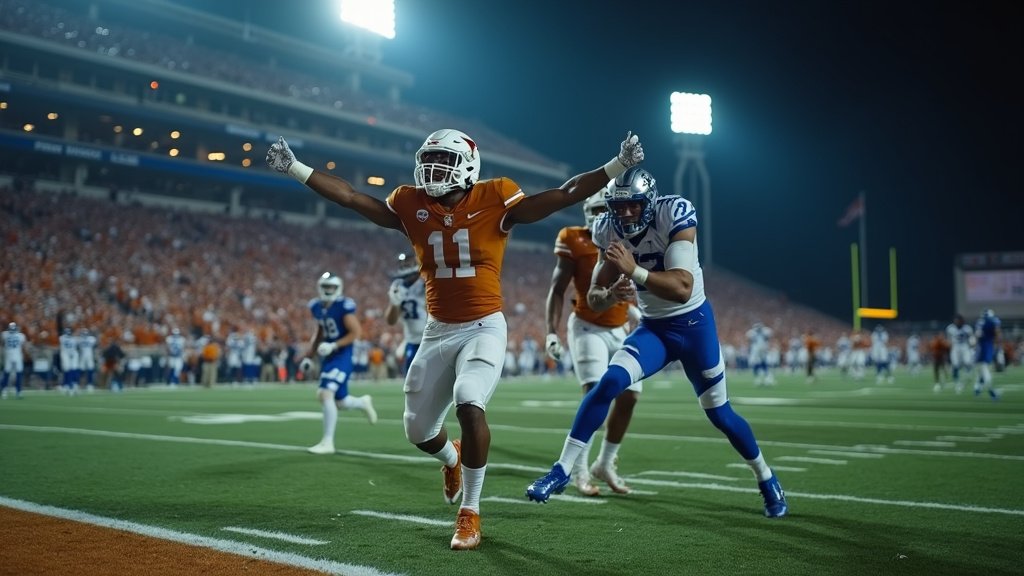
In a dramatic contest that defied conventional statistics, the No. 21 Texas Longhorns narrowly escaped Lexington with a 16-13 overtime victory over the Kentucky Wildcats. While the scoreline suggests a tight battle, the underlying narrative reveals a stark contrast: Texas managed to do just enough to secure the win, while Kentucky, despite outplaying their opponent in many facets, ultimately failed to capitalize on their efforts. This hard-fought game, a piece of college football news that will be debated for days, underscored the brutal realities of winning and losing in the Southeastern Conference.
The Statistical Imbalance
By all objective measures on the stat sheet, Kentucky should have emerged victorious. The Wildcats dominated the line of scrimmage, controlling the clock with nearly 40 minutes of possession compared to Texas’s just under 21. They amassed a staggering 395 total yards of offense against a Texas defense that was on the field for an exhausting 86 plays. Kentucky’s defense also stifled the vaunted Texas offense, holding them to a meager 179 total yards. Furthermore, Kentucky’s redshirt freshman quarterback, Cutter Boley, delivered a performance that statistically outshone his highly touted Texas counterpart, Arch Manning. Boley completed an impressive 31 of 39 passes for 258 yards and added a rushing touchdown, while Manning struggled, finishing 12 of 27 for only 132 yards and no scores. Despite this statistical superiority, the Wildcats left Kroger Field with their ninth consecutive SEC loss.
Defensive Prowess Meets Offensive Stumbles
Kentucky’s defense, marshaled by coordinator Brad White, put on a masterclass. They consistently pressured Arch Manning, sacking him multiple times and forcing punts throughout the early stages of the game. The unit bent but rarely broke, preventing Texas from sustaining drives and forcing them into difficult situations. However, this defensive tenacity was repeatedly undermined by the Wildcats’ offense. Early in the game, Kentucky controlled the ball and moved into scoring position, only to turn the ball over on downs after failing to convert crucial short-yardage situations. This pattern of offensive inconsistency, a recurring theme for the Wildcats, became the story of the game. Despite the defense’s best efforts, the offense could not consistently convert when it mattered most.
Special Teams: The Game-Changing Factor
In a contest where offensive execution was at a premium, special teams played an outsized role. The game’s pivotal moments were undeniably linked to the electrifying punt returns of Texas’s Ryan Niblett. In the second quarter, Niblett turned a punt into a 45-yard gain, setting up a short field for Texas’s only touchdown of regulation. Later, in the fourth quarter, after Kentucky had tied the game, Niblett again provided a massive spark with a 43-yard return, positioning the Longhorns for a go-ahead field goal. These explosive plays, which directly translated into points, were the difference-makers for Texas, highlighting how special teams can swing the momentum and the outcome of a close contest.
The High Cost of Missed Opportunities
Kentucky’s inability to seize critical opportunities proved to be their undoing. Beyond the early fourth-down failures, the Wildcats had a chance to gain crucial points before halftime. Facing a 7-0 deficit, they drove into Texas territory, but a costly sack pushed them out of field goal range, leading to a missed 53-yard attempt as time expired. In overtime, the narrative repeated. Kentucky gained possession deep in Texas territory, reaching the 1-yard line, but again failed to punch it in, resorting to predictable inside runs that were stuffed by the Longhorn defense. This recurring theme of stalling in the red zone and failing on fourth down became a costly refrain in this news report of the game. It represented a failure to finish, a critical deficiency that separated the two teams.
The Lingering SEC Losing Streak
For Kentucky, this overtime loss is more than just a single game; it extends a painful trend. This marks their ninth consecutive loss in SEC play, continuing a frustrating streak that has plagued the program. Despite playing competitively and often outperforming their opponents on paper, the Wildcats have struggled to secure victories against conference foes. This latest defeat reinforces the narrative of a team that can hang with the best but lacks the clutch execution and resilience to close out games. As the season progresses, the pressure to break this cycle will undoubtedly intensify.
Conclusion: Texas Did Enough, Kentucky Didn’t
In the end, this college football news story is about efficiency and execution. Texas, playing a largely uninspired offensive game, relied on the heroics of its defense and special teams to survive. Ryan Niblett’s punt returns and Mason Shipley’s clutch kicking provided the spark. The defense’s goal-line stand in overtime sealed the win. For Kentucky, the analysis is more complex. They possessed the statistical advantages, the defensive swagger, and a quarterback playing above expectations. Yet, their inability to convert on critical downs, capitalize on defensive momentum, and avoid costly mistakes meant they could not quite do enough. In a sport that often boils down to a few crucial plays, Texas found a way to make theirs, while Kentucky could not, offering a poignant editorial on what it takes to win.