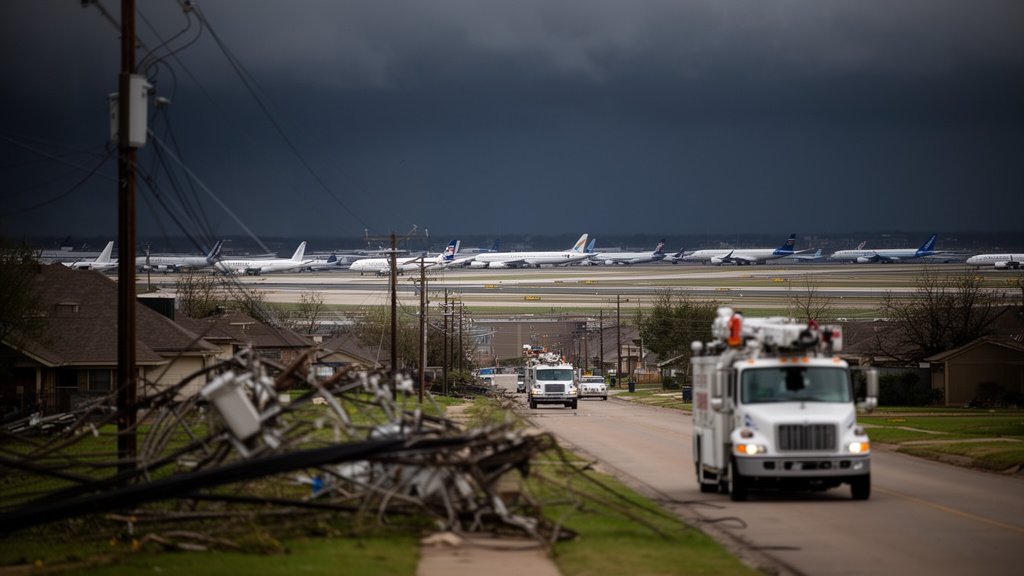
Hurricane Polo has unleashed a wave of severe weather across North Texas, plunging thousands of residents into darkness and bringing regional air travel to a virtual standstill. The storm, which tracked inland with surprising intensity, has forced energy providers and aviation authorities to scramble as they attempt to manage the cascading failures of infrastructure across the Dallas-Fort Worth metroplex.
Key Highlights:
- Power Grid Instability: Oncor and regional energy cooperatives report over 150,000 customers currently without electricity as high winds topple utility poles and debris damages transmission lines.
- Aviation Gridlock: Dallas-Fort Worth International Airport (DFW) and Dallas Love Field have collectively reported over 450 flight cancellations, with delays rippling throughout the national airspace system.
- Emergency Response: Local emergency management agencies have activated severe weather protocols, prioritizing the restoration of power to critical facilities including hospitals and emergency communication centers.
- Storm Trajectory: The remnants of Hurricane Polo have sustained high-velocity gusts, with the National Weather Service (NWS) issuing multiple flash flood warnings for Tarrant and Dallas counties.
The Aftermath of Hurricane Polo: An Infrastructure Stress Test
The Fragility of the North Texas Power Grid
The rapid intensification of the storm system linked to Hurricane Polo has acted as a stress test for the North Texas electrical grid, exposing vulnerabilities in local distribution networks. As the storm front swept through the region, sustained winds exceeding 60 mph caused widespread damage to the aging utility infrastructure. Oncor Electric Delivery, the primary transmission and distribution service provider for the area, has deployed hundreds of repair crews, but the sheer volume of downed power lines has hindered rapid restoration efforts.
The outage reports are concentrated in the northern suburbs of the Dallas-Fort Worth metroplex, where tree canopy density is higher, leading to increased damage to residential lines. The situation highlights an ongoing concern regarding the resilience of Texas’s energy infrastructure during extreme weather events. While the main ERCOT (Electric Reliability Council of Texas) grid has maintained overall frequency stability, the localized distribution failures underscore the necessity for continued investment in undergrounding critical infrastructure and increasing vegetation management budgets. Experts are calling for a thorough audit of the response protocols following the restoration of power to ensure that communication between utility providers and municipal emergency services is streamlined for future events.
Aviation Gridlock: The DFW and Love Field Logistics Nightmare
For the thousands of travelers attempting to navigate the North Texas aviation hub, the impact of Hurricane Polo has been catastrophic. Dallas-Fort Worth International Airport, one of the busiest global transit points, was forced to suspend ground operations for several hours as the convective cell passed directly over the airfield. The resulting ground stop created a domino effect, leading to over 300 cancellations at DFW alone, while Dallas Love Field reported an additional 150 disruptions as crews struggled to manage ramp operations in high-wind conditions.
The logistical challenge of managing such a massive cancellation event is compounded by the crew displacement issues that follow. When pilots and flight attendants are timed out or stranded in the wrong geographic locations due to these sudden, massive cancellations, the recovery time for airlines extends well beyond the clearing of the storm itself. Travelers are being advised to check their flight status directly through airline applications rather than airport information boards, which are lagging behind the rapidly changing conditions. The secondary economic impact of these grounded flights is significant, costing millions in lost productivity and passenger accommodation expenses.
Long-Term Climate Implications and Future Resilience
As North Texas continues to experience more frequent and severe weather phenomena linked to shifting hurricane patterns, there is a growing debate regarding the region’s long-term adaptation strategies. Hurricane Polo, which maintained surprising structural coherence deep into the Texas interior, serves as a harbinger for potentially more intense inland storm impacts in the future. City planners and civil engineers are currently evaluating the construction standards for new developments, specifically regarding high-wind resilience and drainage capacity. The economic vitality of the region is inextricably linked to the reliability of its transit and power systems. Therefore, the lessons learned from this week’s storm—specifically regarding the coordination between the National Weather Service, major utility providers, and transit authorities—will likely dictate policy changes in the next legislative session. The goal is to move from a reactive posture toward a predictive one, utilizing real-time meteorological modeling to pre-stage repair crews and manage flight paths before the storm reaches critical population centers.
FAQ: People Also Ask
Q: Why was the power grid affected so quickly by this storm?
A: The storm’s high-velocity winds caused significant damage to local distribution lines. While the ERCOT grid maintained stability, local infrastructure managed by providers like Oncor sustained damage from downed trees and debris, leading to localized outages.
Q: When will my flight be rescheduled after these cancellations?
A: Recovery times vary by airline. Due to crew displacement and aircraft positioning issues, it may take 24 to 48 hours for flight schedules at DFW and Love Field to fully normalize.
Q: Are there flash flood concerns associated with Hurricane Polo’s remnants?
A: Yes, the National Weather Service has issued multiple flash flood warnings. Residents are urged to avoid driving through high water, as road conditions can change rapidly.
Q: How can I check if my home is affected by the power outages?
A: Most utility providers in North Texas offer online outage maps. It is recommended to use your mobile device’s cellular data to check these portals or contact your provider’s customer service line.