

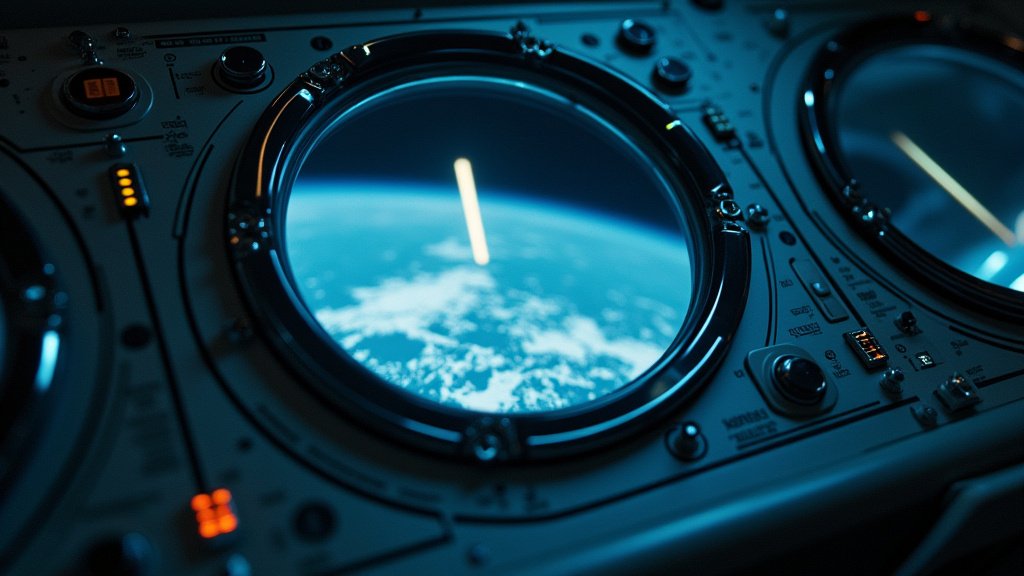
The Orion spacecraft, carrying NASA astronauts Reid Wiseman, Victor Glover, Christina Koch, and CSA astronaut Jeremy Hansen, successfully splashed down in the Pacific Ocean off the coast of San Diego on April 10, 2026, marking the triumphant conclusion of the historic Artemis II mission. The splashdown, which occurred at 8:07 p.m. EDT, represents the first time humans have returned from the vicinity of the Moon in over five decades, setting the stage for future lunar landings and the long-term human exploration of deep space.
Key Highlights
- Historic Return: The crew safely completed a 10-day journey, traveling roughly 695,000 miles around the Moon and back.
- Netflix Integration: The mission was made accessible to a global audience through a live stream partnership with Netflix, integrating NASA+ programming directly into the streaming platform.
- Mission Success: The Orion capsule, named “Integrity,” successfully navigated re-entry through Earth’s atmosphere, enduring temperatures of 5,000 degrees Fahrenheit.
- Future Foundations: This mission paves the way for Artemis III, which is slated to be the first crewed landing on the lunar surface since the Apollo program.
The Return of Humanity to the Deep Frontier
The successful splashdown of Artemis II is more than just a technological milestone; it is a cultural and scientific watershed moment. For the first time since the Apollo 17 mission in 1972, humanity has sent explorers beyond the low-Earth orbit (LEO) environment and back again. The mission was designed as a critical test of the Orion spacecraft’s life support, communications, and navigation systems, all of which performed within operational parameters during the high-stakes lunar flyby.
The Netflix Effect: Democratizing Space Coverage
One of the most notable aspects of the Artemis II mission was its unprecedented level of accessibility. By leveraging the Netflix infrastructure to carry NASA+ live programming, the agency effectively brought the complexities of deep-space exploration into millions of living rooms. This strategy mirrors a shift in how government agencies communicate with the public, opting for widely used streaming platforms over traditional, siloed broadcast channels. The decision to stream the splashdown live—including the critical re-entry and recovery phases—allowed audiences worldwide to witness the precision of the U.S. Navy and NASA recovery teams in real-time. This integration served as a powerful tool to engage younger generations and re-ignite the global fascination with lunar exploration.
Technical Mastery and Re-entry Challenges
Re-entry is famously the most perilous phase of any space mission. As the Orion capsule slammed into the Earth’s atmosphere at extreme velocities, it created a plasma layer that temporarily obstructed communications—a routine but intense reminder of the violent nature of space travel. The thermal protection system, which faced scrutiny following minor anomalies in the uncrewed Artemis I test, performed flawlessly this time, despite the intense 2,760-degree Celsius environment. The precision of the ‘bullseye’ landing off the coast of San Diego demonstrated the maturation of the spacecraft’s design, validating NASA’s engineering adjustments and the collaborative work with contractors like Lockheed Martin.
Decoding the Future of the Artemis Program
With the crew now safely aboard the USS John P. Murtha and undergoing medical evaluation, the focus shifts immediately to data analysis. Engineers will now begin the rigorous process of inspecting the Integrity capsule to understand how the components withstood the lunar environment. This data is the golden ticket for the Artemis III mission, which aims to place the first woman and first person of color on the lunar surface. The mission proved that the SLS (Space Launch System) and Orion are not just prototypes, but operational vehicles capable of sustained deep-space operations. As NASA looks toward 2028, the success of this mission provides the political and scientific momentum required to maintain the cadence of exploration.
FAQ: People Also Ask
Q: Will Netflix continue to air live NASA missions?
A: Yes, the collaboration between NASA and Netflix is part of a larger initiative to provide NASA+ programming on mainstream streaming platforms, making space science more accessible to the public.
Q: Why was this mission considered more difficult than Apollo?
A: While Apollo missions were focused on rapid lunar landings using 1960s-era computing, Artemis II utilizes vastly more complex, modern technologies and a different trajectory, requiring precise navigation to support long-term sustainability rather than just short-term exploration.
Q: What is the significance of the splashdown location?
A: The Pacific Ocean off the coast of San Diego is a standard recovery zone for NASA, chosen for its favorable conditions and proximity to naval assets, which allows for the rapid retrieval of the crew and the preservation of the spacecraft’s data.
Q: When is the next Artemis mission expected to launch?
A: Artemis III, which is intended to feature a lunar landing, is currently being planned for 2028, building upon the critical performance data gathered during this successful Artemis II flight.