
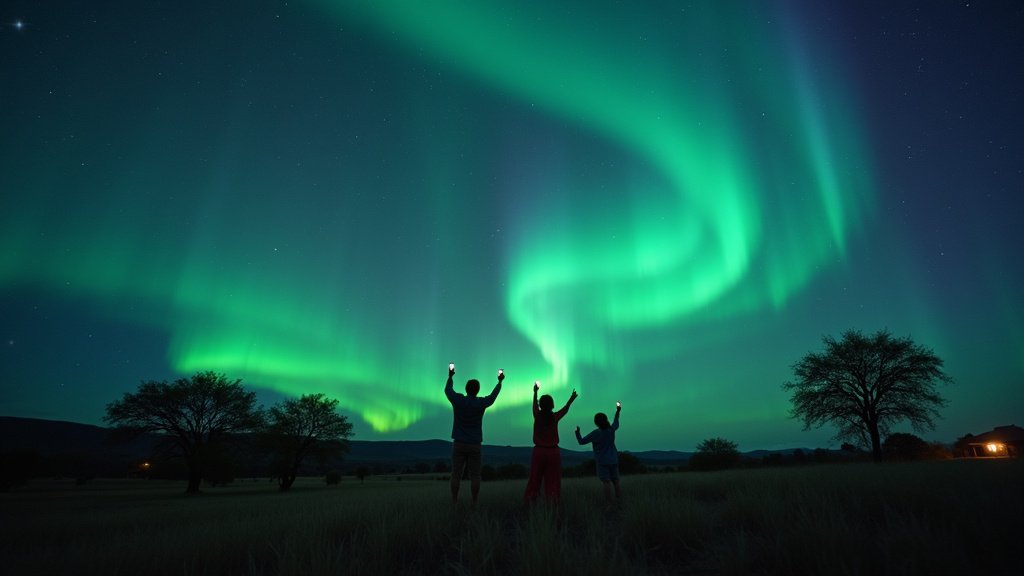
Residents across Texas witnessed a stunning and rare celestial event on Tuesday, November 11, 2025, as the **Texas Aurora** painted the night sky. The breathtaking display was a direct result of a G4-level, or “severe,” geomagnetic storm, a phenomenon that allowed viewers to capture extraordinary **aurora viewer photos** shared via platforms like KSAT Connect. Experiencing the **Texas Aurora** was a once-in-a-lifetime opportunity for many.
The Science Behind the Texas Aurora Spectacle
The aurora borealis, commonly known as the Northern Lights in Texas, occurs when charged particles from the sun collide with gases in Earth’s upper atmosphere. These collisions excite the atmospheric gases, causing them to release energy in the form of light. A geomagnetic storm is a disturbance of Earth’s magnetosphere caused by solar wind, which is a stream of charged particles released from the sun. When these storms are particularly strong, like the G4-level event experienced, the auroras can extend to much lower latitudes than typically observed, making the **Texas Aurora** visible.
A Powerful Solar Outburst Causing Texas Aurora
The G4 geomagnetic storm was triggered by multiple powerful solar events. The primary driver was an X5.1-class **solar flare aurora** that erupted from the sun early Tuesday morning, November 11, 2025. This flare was the most powerful of the year and was accompanied by coronal mass ejections (CMEs)—large expulsions of plasma and magnetic fields from the sun’s corona. Two previous CMEs, launched on November 9 and 10, also contributed to the geomagnetic activity impacting Earth. The Space Weather Prediction Center (SWPC) of the National Oceanic and Atmospheric Administration (NOAA) had issued a severe G4 geomagnetic storm watch in anticipation of these events. G4-level watches are considered rare, with only a few issued so far in the current solar cycle, increasing the rarity of the **Texas Aurora**.
Texas Aurora Visible Across the Lone Star State
For much of the United States, including Texas, the forecast indicated that the **Northern Lights Texas** could be visible far south of its typical polar range. While the most intense activity was expected to impact Earth around midday Wednesday, November 12, G4-level conditions were detected as early as 7:40 p.m. CT on Tuesday, November 11. Reports from across Texas confirmed the aurora’s presence, with residents sharing stunning images of the **Texas Aurora** from various locations. KSAT Connect received numerous submissions from viewers in areas such as the Hill Country, San Antonio, Hondo, Fair Oaks Ranch, and Stone Oak. Other parts of the state, including the Panhandle, Crystal Beach, and Cleveland, also reported sightings of the **Texas Aurora**. Even in North Texas, locations like Azle and Santo saw the lights, with some sightings occurring earlier than initially forecast.
Rarity and Viewer Experience of the Texas Aurora
Auroras are a rare sight in Texas, making this **Texas Aurora** event particularly noteworthy. While previous aurora sightings have occurred in the state, such as during a G5 storm in May 2024, the G4-level storm on November 11, 2025, provided a spectacular and widespread display. Experts recommend viewing auroras in dark locations away from city lights to best appreciate the phenomenon. For many, the **Texas Aurora** was most effectively captured using smartphone cameras, which can detect fainter lights than the human eye. The KSAT Weather Authority team noted that conditions can change rapidly and encouraged viewers to periodically look north throughout the night. Seeing the **Texas Aurora** was a highlight for many residents.
Broader Implications of the Storm and the Texas Aurora
Beyond the visual spectacle of the **Texas Aurora**, severe geomagnetic storms like this G4 event can have broader implications. NOAA has indicated that such storms can cause disruptions to critical infrastructure technology, including power grids, low-frequency radio communications, and GPS systems. While the focus for many was on capturing the awe-inspiring **aurora viewer photos** of the **Texas Aurora**, the underlying solar activity highlights the dynamic nature of **space weather Texas** and its potential impact on Earth. The SWPC continues to monitor **space weather Texas**, providing updates on current conditions and forecasts. The current news buzz in Texas was amplified by this rare event and the stunning **Texas Aurora**.
Looking Ahead for Future Texas Aurora Sightings
While the peak of the G4 storm occurred on November 11-12, NOAA forecasts indicated continued geomagnetic storm activity, with a G3 (strong) watch for November 13. This suggests that further, albeit potentially less intense, **Texas Aurora** displays might be possible in the coming nights, though visibility will depend on local conditions and timing. Residents are encouraged to stay informed through official space weather resources for future updates on auroral activity. The ability to see the **Texas Aurora** this far south is a testament to the potent solar activity and a thrilling reminder of the connection between Earth and its star. The phenomenon served as a captivating reminder of the power of **space weather Texas**, with many Texans eager to share their photos and experiences of this unusual celestial event and the spectacular **Texas Aurora**.