
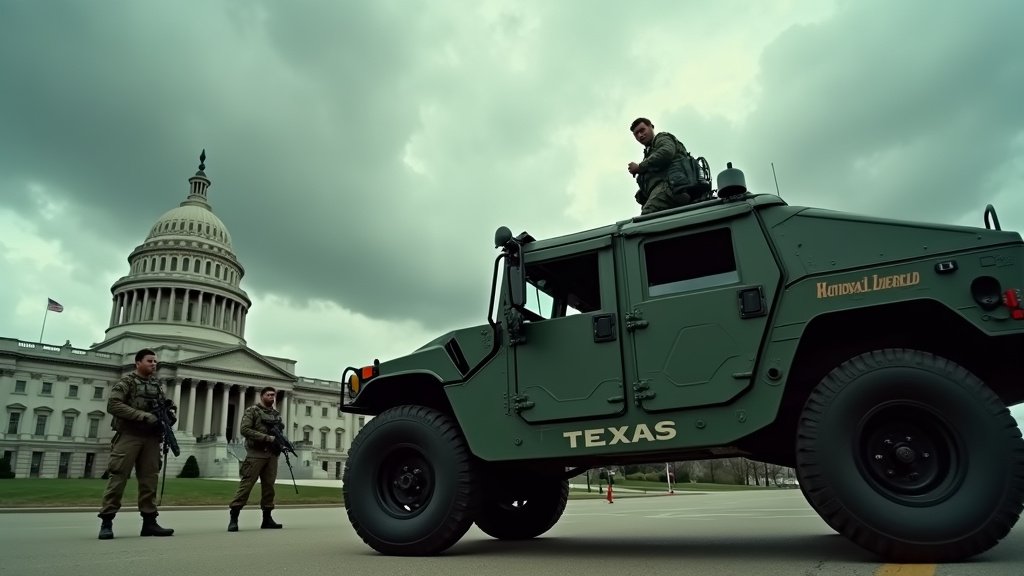
CHICAGO, IL – The recent deployment of Texas National Guard troops to Illinois, authorized by President Donald Trump and sanctioned by Texas Governor Greg Abbott, has ignited a firestorm of legal challenges and political controversy. This unprecedented move, ostensibly to bolster federal immigration enforcement, represents a perilous overreach that undermines state sovereignty, blurs the lines of military neutrality, and sets a troubling precedent for the use of National Guard forces in domestic affairs. The news has drawn sharp criticism from Illinois leaders and legal experts alike, who argue that such actions are not only unlawful but also a dangerous politicization of a critical national resource.
The Deployment and Its Justification
The operation saw up to 400 members of the Texas National Guard dispatched to the Chicago area, with troops beginning to arrive in mid-October 2025. The Trump administration’s stated rationale for this deployment was to protect federal employees and property amidst protests and alleged sporadic violence at Immigration and Customs Enforcement (ICE) facilities. Governor Abbott publicly supported the decision, asserting that the Texas Guard was “putting America first by ensuring that the federal government can safely enforce federal law.” This move was part of a broader federal effort to deploy troops to cities including Portland, Oregon, a move that also met significant legal and political resistance.
State Sovereignty Under Attack
Illinois’s response was swift and unequivocal. Governor J.B. Pritzker vehemently condemned the deployment, labeling it an “invasion” and an “unconstitutional federal overreach.” Alongside Chicago Mayor Brandon Johnson, Governor Pritzker filed a lawsuit arguing that the deployment infringed upon the state’s sovereignty and its right to self-governance. The legal challenge contended that the use of the military for domestic law enforcement, especially without state consent, violates the Posse Comitatus Act. This legal framework generally prohibits the use of the U.S. military for domestic law enforcement purposes. Governor Pritzker accused federal officials of “inciting violence” to create a pretext for deploying armed military personnel, transforming the National Guard into “political props” and “pawns.”
Political Tensions and Federalism Debated
This news has amplified the ongoing debate surrounding federalism and states’ rights. The decision to send troops from one state into another, against the express objections of the home-state governor, is viewed by many as a significant departure from established norms. Oklahoma Governor Kevin Stitt, a Republican and chair of the National Governors Association, criticized Governor Abbott and President Trump for the interstate deployment, stating that it goes against the principles of federalism and “state’s rights.” He argued that rather than deploying troops from another state, the President should have federalized Illinois’s own National Guard if federal intervention was deemed necessary. Critics argue that Governor Abbott’s actions, driven by political considerations and a desire to align with the President, represent a “perilous misuse of resources” and an “abuse” of the Texas National Guard itself, potentially harming its readiness and the welfare of its members. Past criticisms of Texas’s “Operation Lone Star” have pointed to pay issues, poor working conditions, and potential oversteps in border security missions.
The Erosion of National Guard Neutrality
Beyond the immediate legal and political battle, the deployment raises profound concerns about the politicization of the National Guard. The National Guard is constitutionally mandated to serve both state and federal interests, but its role as a politically neutral force is crucial for maintaining public trust. Polls conducted amidst these events indicate that a significant majority of Americans believe the military should remain politically neutral and should not take sides in domestic policy debates. Using National Guard units as instruments to impose a president’s political agenda on a state that objects risks turning a citizen defense force into a partisan tool, thereby undermining its integrity and its crucial apolitical role.
Judicial Scrutiny and Legal Ramifications
Federal courts have become a critical arena in this conflict. U.S. District Judge April Perry temporarily blocked the deployment of Texas National Guard troops to Illinois, stating she found “no credible evidence that there is a danger of rebellion in the state of Illinois.” Judge Perry’s ruling highlighted that the protests did not meet the high legal bar required to justify such a federal intervention. The administration’s push for deployment, including appeals to overcome judicial blocks, signifies a willingness to test the boundaries of presidential authority. The administration’s justification, based on a contested interpretation of “rebellion” or “insurrection,” has been met with skepticism. The outcome of these legal battles could set significant precedents for future federal-state relations concerning military deployments and the limits of executive power.
A Troubling Trend
The deployment of the Texas National Guard to Illinois is more than just a jurisdictional dispute; it is an editorial statement on the state of American federalism and the integrity of its military institutions. It underscores a worrying trend of using military assets for political leverage, potentially at the expense of constitutional principles, states’ rights, and the apolitical nature of the National Guard. As the legal challenges proceed, the core question remains: can the nation protect its borders and enforce its laws without sacrificing the foundational tenets of its democratic system and the trust placed in its citizen soldiers?